Thursday, May 26, 2022

Christ on His Passion, on Humility and on Scandal

St Mark Chapter IX : Verses 29-49

Christ's prediction of His Passion


And he taught his disciples,and said to them:
The Son of man shall be betrayed... J-J Tissot.
[29] And departing from thence, they passed through Galilee, and he would not that any man should know it. 
[30] And he taught his disciples, and said to them: The Son of man shall be betrayed into the hands of men, and they shall kill him; and after that he is killed, he shall rise again the third day.
[31] But they understood not the word, and they were afraid to ask him.


Christ's teaching on Humility


[32] And they came to Capharnaum. And when they were in the house, he asked them: What did you treat of in the way? 
[33] But they held their peace, for in the way they had disputed among themselves, which of them should be the greatest. 
[34] And sitting down, he called the twelve, and saith to them: If any man desire to be first, he shall be the last of all, and the minister of all. 


Whosoever shall receive one such child as this in my name... J-J Tissot
[35] And taking a child, he set him in the midst of them. Whom when he had embraced, he saith to them:
[36] Whosoever shall receive one such child as this in my name, receiveth me. And whosoever shall receive me, receiveth not me, but him that sent me.


[37] John answered him, saying: Master, we saw one casting out devils in thy name, who followeth not us, and we forbade him. 
[38] But Jesus said: Do not forbid him. For there is no man that doth a miracle in my name, and can soon speak ill of me. 
[39] For he that is not against you, is for you. 
[40] For whosoever shall give you to drink a cup of water in my name, because you belong to Christ: amen I say to you, he shall not lose his reward.

Christ's discourse on scandal
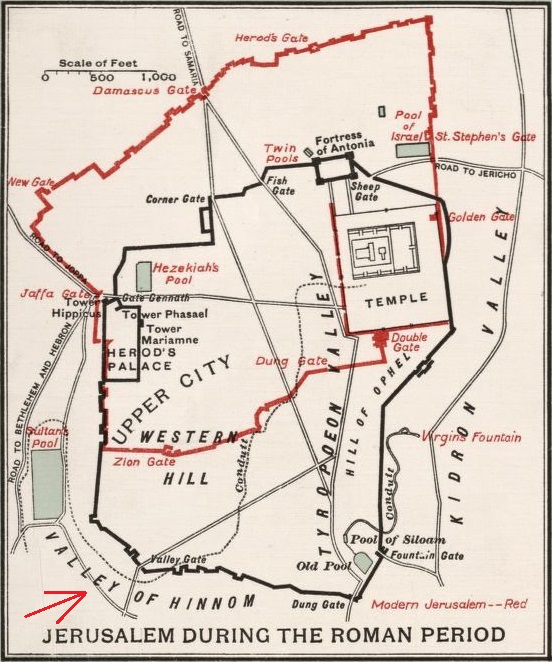

The Valley of Hinnom / Gehenna / Hell. (See Notes below)
[41] And whosoever shall scandalize one of these little ones that believe in me; it were better for him that a millstone were hanged around his neck, and he were cast into the sea. 
[42] And if thy hand scandalize thee, cut it off: it is better for thee to enter into life, maimed, than having two hands to go into hell, into unquenchable fire: 
[43] Where their worm dieth not, and the fire is not extinguished. 
[44] And if thy foot scandalize thee, cut it off. It is better for thee to enter lame into life everlasting, than having two feet, to be cast into the hell of unquenchable fire: 
[45] Where their worm dieth not, and the fire is not extinguished.
[46] And if thy eye scandalize thee, pluck it out. It is better for thee with one eye to enter into the kingdom of God, than having two eyes to be cast into the hell of fire: 


[47] Where their worm dieth not, and the fire is not extinguished. 
[48] For every one shall be salted with fire: and every victim shall be salted with salt. 
[49] Salt is good. But if the salt became unsavoury; wherewith will you season it? Have salt in you, and have peace among you.

[29] Et inde profecti praetergrediebantur Galilaeam : nec volebat quemquam scire. [30] Docebat autem discipulos suos, et dicebat illis : Quoniam Filius hominis tradetur in manus hominum, et occident eum, et occisus tertia die resurget. [31] At illi ignorabant verbum : et timebant interrogare eum. [32] Et venerunt Capharnaum. Qui cum domi essent, interrogabat eos : Quid in via tractabatis? [33] At illi tacebant : siquidem in via inter se disputaverunt : quis eorum major esset. [34] Et residens vocavit duodecim, et ait illis : Si quis vult primus esse, erit omnium novissimus, et omnium minister. [35] Et accipiens puerum, statuit eum in medio eorum : quem cum complexus esset, ait illis :
[36] Quisquis unum ex hujusmodi pueris receperit in nomine meo, me recipit : et quicumque me susceperit, non me suscipit, sed eum qui misit me. [37] Respondit illi Joannes, dicens : Magister, vidimus quemdam in nomine tuo ejicientem daemonia, qui non sequitur nos, et prohibuimus eum. [38] Jesus autem ait : Nolite prohibere eum : nemo est enim qui faciat virtutem in nomine meo, et possit cito male loqui de me : [39] qui enim non est adversum vos, pro vobis est. [40] Quisquis enim potum dederit vobis calicem aquae in nomine meo, quia Christi estis : amen dico vobis, non perdet mercedem suam. [41] Et quisquis scandalizaverit unum ex his pusillis credentibus in me : bonum est ei magis si circumdaretur mola asinaria collo ejus, et in mare mitteretur. [42] Et si scandalizaverit te manus tua, abscide illam : bonum est tibi debilem introire in vitam, quam duas manus habentem ire in gehennam, in ignem inextinguibilem, [43] ubi vermis eorum non moritur, et ignis non extinguitur. [44] Et si pes tuus te scandalizat, amputa illum : bonum est tibi claudum introire in vitam aeternam, quam duos pedes habentem mitti in gehennam ignis inextinguibilis, [45] ubi vermis eorum non moritur, et ignis non extinguitur. [46] Quod si oculus tuus scandalizat te, ejice eum : bonum est tibi luscum introire in regnum Dei, quam duos oculos habentem mitti in gehennam ignis, [47] ubi vermis eorum non moritur, et ignis non extinguitur. [48] Omnis enim igne salietur, et omnis victima sale salietur. [49] Bonum est sal : quod si sal insulsum fuerit, in quo illud condietis? Habete in vobis sal, et pacem habete inter vos.

Notes

Christ's prediction of His Passion

    29. departing from thence. From the scene of the Transfiguration and of the subsequent miracle.
    passed through Galilee. Possibly they did not journey direct from the Mount of the Transfiguration to Capharnaum, but by less frequented routes to ensure privacy. This was the last time Christ was in Galilee. Jesus was now on His last journey to Jerusalem.
    He would not that any mail should know it. To avoid the multitudes and to be free to teach His disciples. It was their last year of training.
    30. taught his disciples. The tense implies “ was continually teaching,” saying, Lay you up in your hearts these words (St Luke ix. 44). As the time of His Passion drew nearer, our Lord very frequently gave His Apostles private instructions.
    betrayed into the hands of men. “ He was delivered up by His Father, who gave Him over to their power. He delivered up Himself voluntarily. He was betrayed into the hands of men, by Judas, who handed Him over to the Scribes and Chief Priests : these delivered Him to Pilate, and Pilate to the soldiers.” ( MacEvilly , Commentary.) This is the first mention of the betrayal.
    hands of men. This was an expression signifying some great misfortune ; thus David chose the pestilence, saying, it is better for me to fall into the hands of the Lord, for His mercies are many, than into the hands of men (1 Par. xxi. 13).
    they shall kill him. Notice the continual repetition of this prediction. He wished to prepare them gradually for His death.
    after that he is killed he shall rise again. Christ’s Resurrection is here very clearly stated, yet the disciples still “ understood not the word.”
    31. they understood not. St Luke adds, it was hid from them so that they perceived it not (ix. 45). These words show the mental state of the disciples. The meaning was like a hidden thing which they could not find. St Peter, however, does not again reject the idea with impetuosity. It was their false preconceptions about the Messiah which prevented them from grasping our Lord’s meaning. St Matthew adds, “ they were troubled exceedingly ” (xvii. 22).
    afraid to ask him : lest they should hear the worst ; doubt left room for a certain hope.

Christ's teaching on Humility

    32. came to Capharnaum. It was on this occasion that St Peter was questioned concerning the tribute money, and Jesus worked a miracle to pay it.
    in the house, he asked them. Jesus avoided compromising the reputation of His followers in the eyes of the people. The true order of events is given by comparing the accounts of the three Evangelists, who complete each other’s narrative : —
    (a) And there entered a thought into them, which of them should be greater (St Luke ix. 46).
    (b) And they came to Capharnaum. And when they were in the house, he asked them , What did you treat of in the way ? (St Mark ix. 32).
    (c) At that hour the disciples came to Jesus, saying , Who thinkest thou is the greater in the kingdom of heaven ? (St Matt, xviii. 1).
    What did you treat of in the way ? Apparently Jesus had walked on ahead alone, or He was engaged in conversation with some of the other disciples.
    33. they held their peace : conscience-stricken, for they had been giving way to ambition. St Matt, says they asked our Lord, Who thinkest thou is the greater in the kingdom of heaven ? (xviii. 1). Evidently it was by a counter-question that they replied, but as regards answering our Lord’s question they were silent. Their thoughts reverted to the kingdom of the Messiah, not to Heaven.
    they had disputed, etc. Perhaps the preference shewn to St Peter, St James, and St John, and their silence as to what took place when our Lord “ led them apart ” had aroused the jealousy of the other apostles. They again disputed about this matter at the Last Supper. The Gospel shews us the Apostles as they were, with all their failings.
    34. sitting down , he called the twelve. Jesus took the attitude of a teacher. All were called to hear His reproof and to learn a lesson of humility.
    desire to be first. If he desire to be first in the kingdom of heaven, let him be content to be last in this world ; i.e. true humility leads to sanctity, which determines our rank in heaven. St Matt, gives the fuller answer, Whosoever therefore shall humble himself as this little child , he is the greater in the kingdom of heaven. And he that shall receive one such little child in my name , receiveth me (xviii. 4, 5). St Luke also gives our Lord’s definite answer to the disciples’ question, For he that is the lesser among you all , he is the greater (ix. 48).
    the minister of all. A second lesson is here inculcated. The Christian must be desirous to serve rather than to be served, to obey rather than to rule.
    35. taking a child. St Matt, gives, calling unto him a little child (xviii. 2).
    Whom when he had embraced. Notice Jesus’ tender love for children. Thus He on another occasion called them to Him and blessed them.
    36. Whosoever shall receive, etc. Hence we see what a glorious work it is to train children for Cod’s sake, as unto Him. By so doing we receive our Lord Himself.
    Note. — The following points in this narrative are peculiar to St Mark —
        (а) Jesus sat down.
        (b) He called all the Twelve.
        (c) He placed the child in the midst.
        (d) He embraced the child.
    37. John answered .... Master, we saw, etc. John “ began to say.” Possibly the words in my name reminded St John of the man whom the disciples had forbidden to exorcise, or he may have thought that Jesus had finished His instruction on humility. Jesus resumed His discourse after having answered St John.
    one casting out devils, etc. It does not follow that the man was not a disciple of Christ. St John says merely, followeth not us, i.e. he was not one of the faithful band of followers who accompanied Jesus in His apostolic journeys.
    we forbad him: much in the same spirit as St John and his brother had desired to call down fire from heaven on the Samaritans, because they received him not, when on the road to Jerusalem, Christ sent messengers before his face. When the “Sons of Thunder” heard this, they said, Lord, wilt thou that we command fire to come down from Heaven , and consume them ? (St Luke ix. 54). In forbidding the man to work miracles, the Apostles acted from a zeal for the honour of their Master, just as Josue had acted, when he asked Moses to forbid Eldad and Medad to prophesy, saying, My Lord Moses , forbid them. Moses, however, meekly replied, Why hast thou emulation for me ? 0 that all the people might prophesy, and that the Lord would give them his Spirit ! (Numbers xi. 28, 29).
    38. Do not forbid him : because he was “ with ” Christ, though not an apostle. It was also a lesson to the Apostles, that just as they were not to seek pre-eminence over each other, so they were not to be jealous of others working miracles in the name of Christ.
    no man that doth a miracle, etc. Christ teaches that those who have sufficient faith to work a miracle in His Name will not speak against Him.
    39. he that is not against you : i.e. if a man does not oppose, you count him as a friend, since he does not hinder your work.
    40. whosoever shall give you to drink, etc. In the East, a cup of cold water was frequently asked for as an alms. It had more value than in our country, on account of the need of the recipients, and of the scarcity of water. The Apostles when sent out on their mission had depended for food and shelter on the hospitality of strangers, and would many a time have asked for “ a cup of cold water. ”

Christ's discourse on scandal

    41. whosoever shall scandalize , etc. See Additional Notes, Chap. vi.1-6.
    one of these little ones. The meaning is not restricted to a child. Our Lord’s thought here embraces all who are weak and lowly in this world, i.e. those who are spiritually infirm, those who hold a low place in the world’s estimation.
    that believe in me. This bears out our Lord’s doctrine that He considers a good work done to “ one of these little ones ” for His sake as done unto Himself, so He resents and avenges, as a personal affront, any injury done to the lowest of His followers.
    a millstone: literally, a millstone which it would take an ass to move. In southern Palestine there are no mill-streams. “ You observe that two women sit at the mill facing each other ; both have hold of the handle by which the upper is turned round on the ‘nether’ millstone. The one whose right hand is disengaged throws in the grain as occasion requires through the hole in the upper stone, which is called the rekkab (rider) in Arabic, as it was long ago, in Hebrew. Both retain their hold, and pull to, or push from, as men do with the whip or crosscut saw.” — The Land and the Book (Thomson). For domestic purposes corn was often ground by women in a hand mill. Our Lord refers to one of these mills when He says, Two women shall be grinding at the mill ; one shall be taken, and one shall be left (St Matt. xxiv. 41).
    a millstone were hanged about, etc. Christ here teaches that death is to be chosen when scandal is the only other alternative. This method of killing a man was not a Jewish punishment, but it was in common use by the Greeks, Romans, Syrians and Phoenicians. In Turkey it is still practised.
    42. if thy hand scandalize thee, etc., — i.e. if anything which is as dear to you as a hand or foot hinders your salvation, renounce it completely. Christ passes from the condemnation of what might ensnare a weaker brother in Christ, to the consideration of anything which might be an obstacle to salvation. These dangers must at all costs be avoided ; if, therefore, bodily ease, worldly possessions, earthly affection or criminal passions jeopardise our salvation, though as dear as a hand, a foot, or an eye, they must be sacrificed. “ The hand denotes government and power ; the foot, exertion and activity ; the eye, knowledge and wisdom” (Maas, S.-J.). With the hand we do wrong, with the foot we go astray, and with the eye we look on sinful objects.
    it is better for thee, etc. This, of course, is metaphorical, since all glorious bodies will be perfect. The thought is that it would be preferable to pass a blissful eternity (were it possible to do so) with a maimed body, than to suffer eternally in hell with all our members.Our Lord uses here, as indeed He does frequently, the language of “accommodation.” The Jews had an intense horror of mutilation, because they believed that a member which was lost, would be missing when they rose from the dead.

Valley of Hinnom. J-J Tissot.
    
into hell, literally Gehenna, “ of fire ” (ver. 46). The Ravine of Hinnom, referred to in Isaias as Topheth, For Topheth is prepared from yesterday, prepared by the king, deep and wide. The nourishments thereof are fire and much wood: the breath of the Lord as a torrent of brimstone kindling it (xxx. 33). Josue describes it as going down to that part of the mountain that looketh on the valley of the children of Ennom . ... by the side of the Jebusite to the south (xviii. 16). Hence it lay south of Mt. Sion. It is one and a half miles in length, and forms a deep, solitary glen, surrounded by rugged cliffs and barren mountains. This place was considered as symbolical of the place of eternal torments, because under Achaz and Manasses, horrible rites in honour of Molech and Chemosh were performed there, and victims were burnt alive. An immense hollow brass idol, containing a powerful furnace, was placed at the opening of the ravine, and the Israelites used to place their children in the red-hot arms of the idol, while trumpets and cymbals were sounded to drown the cries of the victims. Josias put a stop to these infamous practices by burning the dead bones of men there, hence the idolaters deemed the valley polluted. From that time the place was used as a sewer, for burning dead bodies, and as a place of sepulture ; as fires were frequently kindled to consume the filth and corrupt refuse that was thrown there, it was indeed “a place of torment” even to behold, and suggested to the Jews the place of eternal tortures. Having become “the scene of pollution, wickedness, and torment, it became a fit emblem of everlasting punishment” (Barclay).
    into unquenchable fire. A proof of the eternity of the torments of hell. The words of the text as they stand in verse 42 are considered as authentic, since they are found in all the ancient MSS. of the Gospel of St Mark, whereas the repetition of those words in verses 43 and 45 rests on doubtful authority, as they are omitted in some of the best MSS.
    43. Where their worm dieth not , etc. A quotation from Isaias (lxvi. 24), where the prophet speaks of the dead bodies of the enemies of Israel, which were piled up and burnt, while the worms aided in the work of destruction. The fire and the worms continued their work till the bodies were reduced to ashes. Our Lord applies this to the lost souls cast into hell, where the worm, i.e. the remorse of conscience and the fire of God’s avenging justice, shall never cease to torture them. Isaias speaks only metaphorically of the worm and the fire to express that the true worshippers of the God of Israel shall see their enemies destroyed as totally as the dead bodies'of evil doers that were burnt in the Valley of Hinnom.
    48. For = because. The connection is that hell-fire is unextinguishable, because it preserves its victims as salt preserves food.
    every one shall be salted with fire. Probably this means that —
        (a) As salt preserves food from putrefaction, so the “fire” of hell will preserve its victims from destruction that they may suffer unceasingly.
        (b) Every Christian must practise self-denial, which, like salt, prevents our passions from degenerating into corrupt actions,     every victim shall be salted with salt. It was customary to sprinkle the sacrifices with salt. Whatsoever sacrifice thou offerest, thou shalt season it with salt, neither shalt thou take away the salt of the covenant of thy God from thy sacrifice. In all thy oblations thou shalt offer salt (Lev. ii. 13). St Paul exhorted the Romans in these words, I beseech you therefore, brethren, by the mercy of God , that you present your bodies a living sacrifice, holy, pleasing unto God, your reasonable service (xii. 1). Therefore the Christian, if he is to be a living sacrifice, must be salted with mortification and self-denial.
    49. become unsavoury. The salt in common use in Palestine contained a large proportion of lime ; if exposed to rain or sunshine, it became insipid.
    Have salt in you. Salt among the Jews was the sign of perpetual friendship, and no Oriental to this day will injure a man with whom he has eaten salt. Hence our Lord exhorts His disciples to make with each other a “ covenant of salt,” i.e. of lasting friendship, and thus petty strife concerning priority will be avoided.
    have peace among you : by the practice of self-renunciation and humility, the double lesson which our Lord has inculcated in this discourse to His Apostles. Freedom from selfish aims and interests is a great means of peace, and it was precisely these selfish desires which had led the disciples to dispute among themselves as to who should he the greatest among them.


Totus tuus ego sum
Et omnia mea tua sunt;
Tecum semper tutus sum:
Ad Jesum per Mariam.

Wednesday, May 25, 2022

Healing of the Demoniac Boy

St Mark Chapter IX : Verses 13-28


If thou canst believe, all things are possible to him
that believeth.. J-J Tissot.
[13] And coming to his disciples, he saw a great multitude about them, and the scribes disputing with them. 
[14] And presently all the people seeing Jesus, were astonished and struck with fear; and running to him, they saluted him. 
[15] And he asked them: What do you question about among you?
[16] And one of the multitude, answering, said: Master, I have brought my son to thee, having a dumb spirit. 
[17] Who, wheresoever he taketh him, dasheth him, and he foameth, and gnasheth with the teeth, and pineth away; and I spoke to thy disciples to cast him out, and they could not. 
[18] Who answering them, said: O incredulous generation, how long shall I be with you? how long shall I suffer you? bring him unto me. 
[19] And they brought him. And when he had seen him, immediately the spirit troubled him; and being thrown down upon the ground, he rolled about foaming. 
[20] And he asked his father: How long time is it since this hath happened unto him? But he said: From his infancy:
[21] And oftentimes hath he cast him into the fire and into waters to destroy him. But if thou canst do any thing, help us, having compassion on us. 
[22] And Jesus saith to him: If thou canst believe, all things are possible to him that believeth. 
[23] And immediately the father of the boy crying out, with tears said: I do believe, Lord: help my unbelief. 
[24] And when Jesus saw the multitude running together, he threatened the unclean spirit, saying to him: Deaf and dumb spirit, I command thee, go out of him; and enter not any more into him. 
[25] And crying out, and greatly tearing him, he went out of him, and he became as dead, so that many said: He is dead.
[26] But Jesus taking him by the hand, lifted him up; and he arose. 
[27] And when he was come into the house, his disciples secretly asked him: Why could not we cast him out? 
[28] And he said to them: This kind can go out by nothing, but by prayer and fasting.

[13] Et veniens ad discipulos suos, vidit turbam magnam circa eos, et scribas conquirentes cum illis. [14] Et confestim omnis populus videns Jesum, stupefactus est, et expaverunt, et accurrentes salutabant eum. [15] Et interrogavit eos : Quid inter vos conquiritis? [16] Et respondens unus de turba, dixit : Magister, attuli filium meum ad te habentem spiritum mutum : [17] qui ubicumque eum apprehenderit, allidit illum, et spumat, et stridet dentibus, et arescit : et dixi discipulis tuis ut ejicerent illum, et non potuerunt. [18] Qui respondens eis, dixit : O generatio incredula, quamdiu apud vos ero? quamdiu vos patiar? afferte illum ad me. [19] Et attulerunt eum. Et cum vidisset eum, statim spiritus conturbavit illum : et elisus in terram, volutabatur spumans. [20] Et interrogavit patrem ejus : Quantum temporis est ex quo ei hoc accidit? At ille ait : Ab infantia : [21] et frequenter eum in ignem, et in aquas misit ut eum perderet : sed si quid potes, adjuva nos, misertus nostri. [22] Jesus autem ait illi : Si potes credere, omnia possibilia sunt credenti. [23] Et continuo exclamans pater pueri, cum lacrimis aiebat : Credo, Domine; adjuva incredulitatem meam. [24] Et cum videret Jesus concurrentem turbam, comminatus est spiritui immundo, dicens illi : Surde et mute spiritus, ego praecipio tibi, exi ab eo : et amplius ne intrœas in eum. [25] Et exclamans, et multum discerpens eum, exiit ab eo, et factus est sicut mortuus, ita ut multi dicerent : Quia mortuus est. [26] Jesus autem tenens manum ejus elevavit eum, et surrexit. [27] Et cum introisset in domum, discipuli ejus secreto interrogabant eum : Quare nos non potuimus ejicere eum? [28] Et dixit illis : Hoc genus in nullo potest exire, nisi in oratione et jejunio.
ssdd

Notes

    13. coming to his disciples. To the nine who were at the foot of the mountain. This happened the day following (ix. 37), as St Luke tells us. This seems to indicate night as the time when the Transfiguration took place.
    he saw a great multitude. St Luke adds the multitude met Him. 
    the scribes disputing with them. They perhaps hoped to overcome the disciples now that Jesus was absent. Probably they denied that the Apostles could work miracles, even as they denied that Christ had the power to do so.
    14. astonished and struck with fear. The original word denotes extreme terror. The terror of the multitude on seeing Jesus might arise from several causes.
        (a) They did not expect to see Him appear so opportunely.
        (b) Something of the glory of the Transfiguration may still have shone on his face, as the face of Moses shone when he came down from Mount Sinai.
    running to him, they saluted him. Their fear did not overcome their joy at seeing Him.
    15. he asked them, etc. Jesus inquired of those nearest, What do you question about among you ? The father of the lunatic is the only one to answer, falling down on his knees before him saying; Lord, have pity on my son, for he is a lunatic, and suffereth much : for he falleth often into the fire, and often into the water (St Matt. xvii. 14). These are the ordinary symptoms of epilepsy, which the demon probably aggravated, since the boy was possessed by a dumb spirit. The words he is a lunatic shew that the father connects the boy’s convulsions with the changes of the moon.
    16. Master, I have brought my son to thee. The man had brought his son, hoping to find Jesus with the disciples.
    a dumb spirit. Since St Luke tells us he suddenly crieth out (ix. 39), we may conclude the boy could not utter articulate sounds.
    17. wheresoever — whenever. The convulsions were intermittent.
    he taketh him, dasheth him, etc. The father describes minutely the effects of the natural disease of epilepsy, attributing them to the action of the dumb spirit.
    I spoke to thy disciples to cast him out. The man had clearly heard of miracles worked by the Apostles.
    they could not. He attributes the failure to want of power, not lack of good will. The Apostles had tried to cast out the devil, but had failed signally.
    18. 0 incredulous generation. A rebuke to the multitude in general, to the father of the child, and to the Apostles also (indirectly). St Matt, gives unbelieving and perverse generation (xvii. 16).
    how long shall I be with you ? To bear with and to teach you.
    19. when he had seen him, etc. When the devil in the boy was brought close to Jesus. The devils often troubled their victims thus, when in the presence of Jesus.
    20. How long time is it, etc. Our Lord’s question had for object to —
        (a) show His compassion,
        (b) to elicit faith,
        (c) to call attention to the gravity of the boy’s condition.
    21. if thou canst do anything, etc. These words shew that the man’s faith was very weak.
    22. Jesus saith to him, If thou canst, etc. A better translation would be, “Jesus said unto him, as for thy,” “if thou canst,” “all things are possible to him that believeth.” The granting of the grace depended on the suppliant’s faith.
    23. the father .... crying out, with tears said. The man’s tears and cries shew his earnest desire. He felt the weakness of his own faith ; he believed, but would fain have a firmer faith.
    24. when Jesus saw the multitude running together. Apparently Jesus had spoken to His disciples and the man a little apart ; doubtless the boy’s convulsions would have brought the multitude nearer, to see what was happening.
    threatened the unclean spirit: “rebuked” (St Luke). This spirit is characterised as dumb and unclean. These words shew clearly that the boy was possessed. This is an example of a double cure : of healing, and of possession of the devil.
    I command thee. Words of authority. He speaks in His own Name, in virtue of His Divinity.
    enter not any more. The child was thus preserved from future possession by this same spirit.
    25. crying out and greatly tearing, etc. Thus the devil shewed his impotent rage at being forced to relinquish his prey.
    27. his disciples secretly asked him. Naturally they felt the humiliation of having failed to cast out the evil spirit, and especially as their failure was witnessed by the Scribes, and they knew not to what it was to be attributed, since, hitherto, the devils had been subject to them. Only nine of the Apostles asked this question.
    28. he said to them, etc. St Matthew gives a longer answer, Because of your unbelief. For, amen I say to you, if you have faith as a grain of mustard seed, you shall say to this mountain, Remove from hence thither, and it shall remove, and nothing shall be impossible to you (xvii. 19).
    This kind. Particular kind of demon. As there are angels of different degrees of power and glory, so there are some demons who surpass their companions in wickedness, strength, and intelligence.
    prayer and fasting. Some MSS. omit these words, but they are found in the greater number. Fasting was required to add intensity to prayer, and Origen says it should be practised both by the one possessed and by the exorcist. “ The demoniac living luxuriously cannot be delivered from such madness.” (St Chrysostom.) The exorcist should fast that he may first conquer his own inordinate passions before attacking God’s enemies, the devils. Prayer and fasting predispose man to receive graces from God.

Additional Notes

    On prayer and fasting. The utility of fasting as a preparation for spiritual graces, is shown by the following examples: —
    (a) It was when St Peter was “ praying and fasting ” that a vision was granted to him.
    “ Peter went up to the higher parts of the house to pray, about the sixth hour. And being hungry, he was desirous to taste somewhat. And as they were preparing, there came upon him an ecstasy of mind ” ( Acts x. 9-10).
    (b) It was while “ministering to the Lord and fasting ” that the Holy Ghost enlightened the Apostles, regarding the mission of Saul and Barnabas.
    “And as they were ministering to the Lord, and fasting, the Holy Ghost said to them ; Separate me Saul and Barnabas, for the work whereunto I have taken them. Then they fasting and praying, and imposing their hands upon them, sent them away ” ( Acts xiii. 2, 3).
    (c) St Paul speaks of himself as frequently praying and fasting :
    “ In much watchings, in hunger and thirst, in fastings often” (2 Cor. xi. 27), and these penitential works rendered his mission more fruitful.
    Many examples of fasting might be cited from the Old Testament, e.g. Moses, Elias, David, etc. Maldonatus says : Faith expels the enemy by believing, prayer by petitioning, fasting by tormenting and starving him ; as an enemy is driven out of a fortress, not only by force, but by starving him.” The doctrine here formulated by our Lord concerning “ prayer and fasting ” is not contradictory to the answer He made concerning fasting, when questioned by the Pharisees as to why the disciples did not fast. “ Why do the disciples of John and of the Pharisees fast ; but thy disciples do not fast?” (St Mark ii. 18). His answer in that case, “as long as they have the bridegroom with them, they cannot fast” (St Mark ii. 19), referred to fasting of supererogation, which was unseasonable while He was with them. We know that both Jesus and His disciples observed the fasts, imposed by the Law of Moses, since He fulfilled the Law to an iota, but He did not observe the extra fasts prescribed by the Pharisees, nor imitate the rigorous abstinence of St John the Baptist.


Totus tuus ego sum
Et omnia mea tua sunt;
Tecum semper tutus sum:
Ad Jesum per Mariam.

Tuesday, May 24, 2022

The Transfiguration

St Mark Chapter IX : Verses 1-12


This is my most beloved son; hear ye him. J-J Tissot.
[1] And after six days Jesus taketh with him Peter and James and John, and leadeth them up into an high mountain apart by themselves, and was transfigured before them. 
[2] And his garments became shining and exceeding white as snow, so as no fuller upon earth can make white. 
[3] And there appeared to them Elias with Moses; and they were talking with Jesus. 
[4] And Peter answering, said to Jesus: Rabbi, it is good for us to be here: and let us make three tabernacles, one for thee, and one for Moses, and one for Elias. 
[5] For he knew not what he said: for they were struck with fear.
[6] And there was a cloud overshadowing them: and a voice came out of the cloud, saying: This is my most beloved son; hear ye him. 
[7] And immediately looking about, they saw no man any more, but Jesus only with them. 
[8] And as they came down from the mountain, he charged them not to tell any man what things they had seen, till the Son of man shall be risen again from the dead. 
[9] And they kept the word to themselves; questioning together what that should mean, when he shall be risen from the dead. 
[10] And they asked him, saying: Why then do the Pharisees and scribes say that Elias must come first?
[11] Who answering, said to them: Elias, when he shall come first, shall restore all things; and as it is written of the Son of man, that he must suffer many things and be despised. 
[12] But I say to you, that Elias also is come, (and they have done to him whatsoever they would,) as it is written of him.

[1] Et post dies sex assumit Jesus Petrum, et Jacobum, et Joannem, et ducit illos in montem excelsum seorsum solos, et transfiguratus est coram ipsis. [2] Et vestimenta ejus facta sunt splendentia, et candida nimis velut nix, qualia fullo non potest super terram candida facere. [3] Et apparuit illis Elias cum Moyse : et erant loquentes cum Jesu. [4] Et respondens Petrus, ait Jesu : Rabbi, bonum est nos hic esse : et faciamus tria tabernacula, tibi unum, et Moysi unum, et Eliae unum. [5] Non enim sciebat quid diceret : erant enim timore exterriti. [6] Et facta est nubes obumbrans eos : et venit vox de nube, dicens : Hic est Filius meus carissimus : audite illum. [7] Et statim circumspicientes, neminem amplius viderunt, nisi Jesum tantum secum. [8] Et descendentibus illis de monte, praecepit illis ne cuiquam quae vidissent, narrarent : nisi cum Filius hominis a mortuis resurrexerit. [9] Et verbum continuerunt apud se : conquirentes quid esset, cum a mortuis resurrexerit. [10] Et interrogabant eum, dicentes : Quid ergo dicunt pharisæi et scribae, quia Eliam oportet venire primum? [11] Qui respondens, ait illis : Elias cum venerit primo, restituet omnia : et quomodo scriptum est in Filium hominis, ut multa patiatur et contemnatur. [12] Sed dico vobis quia et Elias venit ( et fecerunt illi quæcumque voluerunt) sicut scriptum est de eo.

Notes

1. after six days. “ St Luke says, after eight days, not contradicting St Mark, but most fully agreeing with him. The one expressed both the day on which Jesus spoke ( i.e . His discourse on His Passion) and that on which He led them up, but St Mark speaks only of the days between.” (St Chrysostom, hom, lvi.) The Jews generally reckoned time inclusively (cf. after three days he shall rise again), each part of a day being counted as a whole.
    taketh with him Peter and J ames and John. As He had done when He raised Jairus’ daughter. They were to be the three privileged witnesses of His Transfiguration, that they might be strengthened to witness His agony in Gethsemani ; St Peter, the future Vicar of Christ, St James, the first of the Apostles who suffered martyrdom, and St John, the beloved disciple.
    Note.“ Three” was the number of witnesses legally exacted by the Jewish law. There were also three heavenly witnesses, God the Father, Moses, Elias.
    leadeth them up. “Took” (St Luke), “brought them up” (St Matt.) ; in like manner, on Ascension Day He led them out as far as Bethania (St Luke xxiv. 50). An ancient tradition points out Mount Thabor as the scene of the Transfiguration. It lies to the north-east of the plain of Esdrælon, and stands nearly two thousand feet above sea-level. Later commentators, chiefly non-Catholic, prefer Hermon as the “ high mountain ” in question. The older tradition, however, seems to have greater weight. Two churches, now in ruins, built on Mount Thabor, one by St Helena, probably the other by the Crusaders, testify to the antiquity of this tradition.
    apart by themselves. He led them apart, and then retired Himself to pray ; the ordinary prelude to some event of great moment.
    transfigured: changed in outward appearance. St Luke tells us that whilst he prayed the shape (i.e. the appearance) of his countenance was altered (ix. 29). St Matthew says, His face did shine as the sun (xvii. 2). Our Lord appeared in glory ; the Divine Nature, habitually concealed, now revealed Itself by glorifying the humanity of our Lord. In reality, it was less a miracle than the cessation of the miracle, which had thus kept the Divinity hidden in the Sacred Humanity since the Incarnation. The “clarity” of Jesus’ body was thus visible to the Apostles. The bodies of the just after the resurrection will have the four qualities of clarity , impassibility , agility and spirituality.
2. garments became shining, etc. All three Evangelists note the brightness of our Lord’s garments, and the words failed them to express their dazzling whiteness. They glistened like snow. Perhaps the snow-capped peaks of Lebanon suggested the comparison.
    fuller. One whose trade it is to bleach and cleanse linen.
3. there appeared to them, etc. The three disciples, when thoroughly aroused from their drowsiness, perceived Moses and Elias. St Luke has Two men were talking with him, and they were Moses and Elias (ix. 30). The sign from Heaven demanded by the haughty Pharisees, and refused to them, was granted to the three lowly disciples. The Apostles were heavy with sleep (ix. 32). Some commentators are of opinion that they did not actually give way to sleep, since the words of St Luke, waking they saw him, etc., would, in the original Greek, be better translated “ nevertheless remaining awake.” Others conclude that they actually slept, but were aroused by the brightness of the light and the voices.
    Elias with Moses. The Apostles could only know who they were either —
    (a) By a special revelation.
    (b) By the conversation which took place.
    (c) Perhaps by their appearing as the Jews generally represented them.
    Note.— Moses was the great lawgiver, Elias one of the greatest of the prophets. Hence their apparition with Jesus proved that these leaders whom the Jews professed to follow and obey ( i.e. the Law and the Prophets) acknowledge Jesus as the Messiah.
    were talking with Jesus. They spoke of his decease that he should accomplish in Jerusalem (St Luke ix. 31). This vision corroborated our Lord’s previous prophecy, and mentioned the place of His death. The original word is “ exodus ” or “ going forth.”
4. Peter , answering. As ardent and impetuous as ever. No one had addressed St Peter ; the expression is an ordinary Hebrew idiom meaning “ saying.”
    Rabbi. The usual title of respect given to the Jewish teachers.
    it is good, etc. : literally “ it is very agreeable.” St Peter thought it preferable to remain there, that thus our Lord might avoid His enemies in Jerusalem.
    three tabernacles. Tents of wattled boughs, such as were used at the Feast of Tabernacles. St Peter said these words as Moses and Elias were departing, possibly in hopes of detaining them. “ The Law and the Prophets pass, but Christ remains.”
5. he knew not what he said. He was too much overcome by fear and other emotions to reflect that the Son of man must suffer many things, and that to remain on the Mount of the Transfiguration would be to frustrate this design.
    they were struck with fear. The original is extremely expressive, and implies very great dread or terror.
6. there was a cloud overshadowing them. Moses and Elias had disappeared, and now Jesus and His three Apostles seem to be enveloped in a “bright” cloud. Probably it was the Shechinah or visible glory of God. “ Because it was His desire not to alarm but to teach, it is a bright cloud ” (St Chrysostom ), not a “ very thick” one, as on Mount Sinai.
    a voice came out. The voice of God bearing witness to His Beloved Son. The same words are repeated that were uttered at our Lord’s baptism, with the addition Hear ye him. On hearing the Voice, the Apostles fell on their faces and remained thus, until Jesus came and touched them , and said to them , Arise, and fear not (St Matt. xvii. 7).
    This is my most beloved Son, etc. , — i.e. my Son, the Beloved . The original expression means the only-begotten Son by eternal generation, not “ a son of God ” by adoption, like the blessed and those in a state of grace. St Matthew alone gives the words in full, “ in whom I am well pleased.
7. immediately looking about, etc. Either to see if Moses and Elias had returned, or perhaps with no definite intention, as men gaze about in fear and trembling when greatly terrified.
    Jesus only with them. Their Master was there to reassure them by His loving “ Fear not.” The vision was now over.
8. He charged them, etc. Possibly one reason for this prohibition was, that Jesus did not wish to raise hopes of a Messiah who should triumph as an earthly king. They were not even to reveal it to the other nine apostles, since they were not to tell any man.
what things. The vision, the conversation, etc.
    till the Son of man shall be risen , etc. These words puzzled the Apostles greatly. They had seen Elias, who was to come, and had heard Jesus speak of His passion, and now their lips are sealed as regards the vision until after our Lord’s Resurrection. Hence it is to take place in their lifetime, and He was not referring to the resurrection of the last day.
9. they kept the word. They obeyed the injunction to keep silence, unlike those whom our Lord had healed, and told not to reveal who had cured them.
10. Elias must come first, — i.e. before the Messiah. Possibly the Pharisees had justified their rejection of Christ on the plea that Elias had not yet come.
11. Elias , when he shall come, etc. The prophecies of Malachias run thus, Behold I send my angel , and he shall prepare the way before my face. And presently the Lord , whom you seek, and the Angel of the testament whom you desire , shall come to His temple. Behold He cometh, saith the Lord of hosts (iii. 1). Behold I will send you Elias the prophet , before the coming of the great and dreadful day of the Lord. And he shall turn the heart of the fathers to the children , and the heart of the children to their fathers : lest I come, and strike the earth with anathema (iv. 5, 6). They refer to two different advents of the Messiah and to two precursors ; likewise Jesus in His answer distinguishes between the two precursors ; Elias shall indeed come before the second advent and restore all things, preparing all hearts for the coming of the Lord .... Secondly, Elias is already come, before My first advent, in the person of the Baptist, and they knew him not, but have done unto him whatsoever they had a mind (A. J. Maas , S.J. ). This interpretation is given by Origen, Victorinus, St Chrysostom, St Jerome, St Augustine, and all other later Catholic writers of weight. St Matthew adds that when Jesus had answered His disciples’ question concerning Elias, Then the disciples understood that he had spoken to them of John the Baptist (xvii. 13).

    Note I. — The Transfiguration naturally made a deep impression on the three Apostles. St James the Great did not live long enough to leave his impressions in writing, but St Peter, about thirty-five years after the event, thus wrote, For we have not followed cunningly devised fables, when we made known to you the power and presence of our Lord Jesus Christ : but having been made eye-witness of his majesty. For he received from God the Father, honour and glory : this voice coming down to him from the excellent glory. This is my beloved Son, in whom I have pleased myself, hear ye him. And this voice we heard brought from heaven, when we were with him in the holy mount (2 St Peter i. 16, 17, 18). St John also evidently had the Transfiguration in mind when he wrote the following passages -.— And the Word was made flesh, and dwelt among us (and we saw his glory, the glory as it were of the only -begotten of the Father) full of grace and truth (St John i. 14). That which was from the beginning, which we have heard , which we have seen with our eyes, which we have looked upon, and our hands have handled, of the word of life (1 St John i. 1).

Note II. — There are three details peculiar to St Mark in this narration :
    (a) “ so as no fuller upon earth can make white.”
    (b) the disciples “looking around.”
    (c) their “ questioning together ” concerning Christ's Resurrection.

Additional Notes


The three narratives of the Transfiguration harmonised.

St Matt. xvii. 1-13. St Mark ix. 1-12. St Luke ix. 28- 36.
    (1) It took place on the eighth day (inclusive) after St Peter’s confession of faith.
    (2) Jesus leads Peter, James and John apart up a high mountain.
    (3) Jesus prays, and is transfigured ; Moses and Elias appear and speak with Him concerning His “ decease.”
    (4) The Apostles are aroused from their drowsiness, hear the voices, and see Christ transfigured.
    (5) As Moses and Elias are departing, Peter proposes to build three tabernacles.
    (6) While he is speaking a bright cloud overshadowed them and they were afraid when they entered into the cloud.
    (7) A heavenly Voice is heard saying, “ This is my beloved Son,” etc. ; while this Voice is speaking, Jesus was found alone.
    (8) The Apostles fell upon their faces in fear.
    (9) Jesus touches them and says, “ Arise and be not afraid.”
    (10) They look up “ immediately ” and see no man, but Jesus only with them.
    (11) He charges them to tell no man, until after His Resurrection.
    (12) They obey, but question among themselves.

Sequence of events leading up to the Transfiguration.

    (A) Jesus is rejected by the Pharisees, and He departs from them and leaves Galilee.
    (B) St Peter made his glorious confession of faith in Christ as the Messias, at Cæsarea Philippi, and acknowledged His Divinity.
    (C) Jesus reveals to St Peter his future greatness as Head of the Church.
    (D) The mysteries of the Passion are gradually unfolded to the disciples. St Peter rejects the idea of a suffering Messias.
    (E) Jesus teaches that self-renunciation is necessary for all His followers.
    (F) The Transfiguration reveals to the favoured three, that Christ is the Messias of whom the Prophets spoke, and the Voice from heaven proclaims Jesus to be the “ Son of God.”

Where the Transfiguration took place

Locations of Mt Thabor and Mt Hermon.
    
The earlier traditions nearly all point to Mount Thabor, whereas the more modern writers, particularly the non- Catholic commentators, are of opinion that it must have been on Mount Hermon or Mount Paneas, or some one of the mountains near the sea of Galilee. The following reasons are adduced in favour of Mount Thabor being the high mountain mentioned by the Evangelists : —
    (a) It is a very old tradition established on the authority of ancient writers, St Jerome (378), St Cyril (378), Venerable Bede (731) ; and among later writers we have Maldonatus (1583), Barraclas (1 615), Cornelius a Lapide (1637), etc.
    (b) The churches now in ruins, built on Mount Thabor by St Helena (probably) and by the Crusaders, shew the general acceptation of this tradition.
    (c) Mount Thabor can be called “ a high mountain,” since it is about 2000 feet above sea-level. A fortress had stood there before the time of Christ. Some assert that it was then in ruins, and only rebuilt some years later, but this cannot be proved.
    (d) After the Transfiguration, on coming down from the mountain, Jesus and His three apostles found the other nine apostles with “a great multitude about them, and the scribes disputing with them.” This could scarcely have happened at the foot of Mount Hermon, which was comparatively a desert place.
    (e) The Apostles were endeavouring to exorcise “ a dumb spirit,” and our Lord had particularly forbidden them to exercise their ministry in the territory of the Gentiles.
    (f) Christ and His Apostles could easily have travelled from Cæsarea Philippi to Mount Thabor in six days.
    (g) After the casting out of the dumb spirit we are told that Christ and His Apostles “abode together in Galilee” (St Matt. xvii. 21).
    On the other hand, those who favour the view that Christ was .transfigured on Mount Hermon or some other mountain base their opinion on the following facts : —
    (1) The fortress on Mount Thabor, even if in ruins, would probably have been inhabited.
    (2) Christ would not at once have returned to Galilee, where He was so generally persecuted.
    (3) When St Matthew states that Jesus and His disciples “abode together in Galilee” (xvii. 21), He must have gone there later secretly, since St Mark tells us, “ departing from thence, they passed through Galilee, and He would not that any man should know it” (ix. 29).
    We cannot therefore decide the question absolutely, but the weightier arguments seem to be in favour of Mount Thabor, especially when we remember how tenacious the Orientals are as regards local traditions, and how religiously they hand them down, from generation to generation.

    The bright cloud. In holy Scripture, God is frequently represented as revealing His presence and majesty by a “ cloud.” Thus we read, “ behold, the glory of the Lord appeared in a cloud” (Exod. xvi. 10). “ Lo, now will I come to thee in the darkness of a cloud,” etc. (xix. 9). “ Who makest the clouds thy chariot,” etc. ( Ps . ciii. 3). Many other texts might be cited. St Luke says “ they were afraid when they entered into the cloud ” (ix. 34). It has been questioned to whom the “ they ” refers. Did the disciples enter the cloud ? The most common opinion is that they did, for certainly the first “ they ” refers to the Apostles, and why should they be afraid at seeing the vision disappear ? It would seem that all entered the cloud, then Moses and Elias gradually disappeared. St Peter spoke as though he would hold them back, then the Voice was heard when Jesus was alone and still transfigured.

    The time of the Transfiguration. Was it night or day? The general consensus of opinion leans to night, since —
    (a) Jesus retired to pray, and He was accustomed to retire thus at night.
    (b) The Apostles were heavy with sleep, hence we may conclude it was night.
    (c) St Luke tells us “ the day following, when they came down from the mountain, there met him a great multitude,” etc. This looks as though our Lord and His Apostles had passed the night on the mountain, and that the next day the nine Apostles and the multitude were going up the mount to seek Him and implore His aid.


Totus tuus ego sum
Et omnia mea tua sunt;
Tecum semper tutus sum:
Ad Jesum per Mariam.


Monday, May 23, 2022

Christ rebukes St Peter;

St Mark Chapter VIII : Verses 31-39


And Peter taking him, began to rebuke him... J-J Tissot
[31] And he began to teach them, that the Son of man must suffer many things, and be rejected by the ancients and by the high priests, and the scribes, and be killed: and after three days rise again. 
[32] And he spoke the word openly. And Peter taking him, began to rebuke him. 
[33] Who turning about and seeing his disciples, threatened Peter, saying: Go behind me, Satan, because thou savourest not the things that are of God, but that are of men. 
[34] And calling the multitude together with his disciples, he said to them: If any man will follow me, let him deny himself, and take up his cross, and follow me. 
[35] For whosoever will save his life, shall lose it: and whosoever shall lose his life for my sake and the gospel, shall save it.
[36] For what shall it profit a man, if he gain the whole world, and suffer the loss of his soul? 
[37] Or what shall a man give in exchange for his soul? 
[38] For he that shall be ashamed of me, and of my words, in this adulterous and sinful generation: the Son of man also will be ashamed of him, when he shall come in the glory of his Father with the holy angels. 
[39] And he said to them: Amen I say to you, that there are some of them that stand here, who shall not taste death, till they see the kingdom of God coming in power.

[31] Et cœpit docere eos quoniam oportet Filium hominis pati multa, et reprobari a senioribus, et a summis sacerdotibus et scribis, et occidi : et post tres dies resurgere. [32] Et palam verbum loquebatur. Et apprehendens eum Petrus, cœpit increpare eum. [33] Qui conversus, et videns discipulos suos, comminatus est Petro, dicens : Vade retro me Satana, quoniam non sapis quae Dei sunt, sed quae sunt hominum. [34] Et convocata turba cum discipulis suis, dixit eis : Si quis vult me sequi, deneget semetipsum : et tollat crucem suam, et sequatur me. [35] Qui enim voluerit animam suam salvam facere, perdet eam : qui autem perdiderit animam suam propter me, et Evangelium, salvam faciet eam. [36] Quid enim proderit homini, si lucretur mundum totum et detrimentum animae suae faciat? [37] Aut quid dabit homo commutationis pro anima sua? [38] Qui enim me confusus fuerit, et verba mea in generatione ista adultera et peccatrice, et Filius hominis confundetur eum, cum venerit in gloria Patris sui cum angelis sanctis. [39] Et dicebat illis : Amen dico vobis, quia sunt quidam de hic stantibus, qui non gustabunt mortem donec videant regnum Dei veniens in virtute.
s

Notes

31. he began to teach them , — i.e. the disciples. St Peter had acknowledged Him, in the name of all the others, as the Messiah. They must now learn that the Messiah was not to have a glorious earthly career, but one of humiliation and suffering.
    the Son of man. Jesus’ favourite title for Himself. Only, too, as “ Son of man ” could He suffer and atone for humanity.
    must suffer. There was no other path of Redemption. So, later, He explains His passion, Ought not Christ to have suffered these things and so to enter into his glory ? (St Luke xxiv. 26).
    many things. Some of which will only be revealed in eternity, since all the insults and humiliations to which our Lord was subjected are not detailed in Scripture.
    rejected, — i.e. during the days of His ministry, and also during His Passion. Not this man but Bar abbas (St John xviii. 40).
    ancients. Senators, not necessarily old men ; they formed part of the Sanhedrin, being nominated by those in authority.
    The Sanhedrin consisted of —
    (a) The chief priests. ( b ) The scribes, (c) The elders. Hence our Lord was rejected by the greatest Jewish legislators.
    high-priests, scribes. (See Jewish Sects) 
    be killed. Our Lord announces His death, but not the manner of it. 
    after three days. Not necessarily three full days — one full day and a part of two other days would fall within the meaning of the term. This view is illustrated by St Matt, (xxvii. 63, 64), where the chief priests asked that the sepulchre might be guarded, since Christ had said, After three days I will rise again.
    rise again. This is a clear prophecy of the Resurrection, which the disciples did not grasp.
32. he spoke the word openly. A detail peculiar to St Mark.
    Peter taking him : apart from the others. Possibly he drew our Lord away by the hand or mantle. St Peter was scandalized at the idea of a suffering Messiah ; so were all the Twelve.
    began to rebuke him, — i. e. to reason with our Lord and to endeavour to dissuade Him from suffering. Evidently this unbecoming action was due to St Peter’s natural impetuosity, to his want of spiritual discernment and to his vehement personal love of Jesus. St Matthew gives the exact words, And Peter taking him, began to rebuke him, saying: Lord, be it far from thee , this shall not be to thee (xvi. 22).
33. Who turning about and seeing his disciples. The second graphic touch of St Mark, who alone mentions that Christ looked at the other disciples as well as at St Peter. Our Lord did this to fix their attention ; since they shared St Peter’s sentiments regarding a temporal reign of prosperity, they needed to hear the rebuke addressed to St Peter, that they might profit by the lesson.
    threatened : preferably “ rebuked.”
    Go behind me, Satan. This sharp rebuke seems to betray intense feeling on the part of our Lord. As Man the passion was repugnant to Him, and naturally He could not but shrink from it. St Peter, in striving to persuade Him to give up this method of Redemption, was echoing the previous temptation in the desert, when Satan had promised Jesus all the kingdoms of the earth and the glory of them without suffering. Judas willingly gave himself up to Satan’s suggestions. St Peter did so unconsciously, but nevertheless the temptation existed, or Jesus would not have said, thou art a scandal unto me (St Matt, xvi. 23). Notice, our Lord used exactly the same words in His Temptation in the desert.
    Satan : literally, an adversary, one who opposes ; so Christ speaks of Judas. Jesus answered them, Have not I chosen you twelve; and one of you is a devil ? (St John vi. 71).
    savourest, — i.e. carest for and thinkest of earthly things. St Peter could not grasp the divine plan of redemption. When the cross falls on us, or on those dear to us, we too are apt to repine, and to consider these trials from a mere human standpoint, forgetting that : All things work together unto good, to such as, according to his purpose , are called to be saints (Rom. viii. 28), and that it is through many tribulations we must enter into the Kingdom of God (Acts xiv. 21).

34. calling the multitude. St Matthew mentions only the disciplesSt Luke says He said to all. Doubtless a crowd of faithful disciples and many others were still following our Lord. Naturally at times they would retire to rest apart, and our Lord had Himself just withdrawn to pray in secret. Jesus called them all because the truths He was about to teach concerned “ all.
    with his disciples. Jesus is about to re-enforce the lesson just given privately after St Peter’s presumption.
    If. Jesus forces no man to serve Him. All depends, as far as we are concerned, on our free will, but God gives to all, sufficient grace for salvation. This is an article of faith, i.e. a truth which all Catholics are bound to accept.
    will follow : in the path of suffering and humiliation.
    let him, etc. Notice the three necessary steps if we would be disciples of Christ—
    (a) Self-denial. ( b ) Acceptation of the cross, (c) Imitation of Christ.
    deny himself. Christian self-denial is a Divine precept. The Jews were taught to practise it, since they were commanded to fast rigorously at certain times, and to give certain alms. We are bound to renounce our sinful appetites and passions. Just as the soldier must practise shooting before he goes to the battlefield, so the Christian must deny himself in lesser things (that are not positively evil), that he may acquire the habit of self-renunciation, and be prepared for the greater occasions when self-denial becomes a necessity.
    take up his cross. Each disciple has his own personal cross to bear. Also, there is an indirect allusion here to the Crucifixion of our Lord. Criminals were forced to take up their cross and to carry it to the place of execution. St Luke adds the word “ daily.” Not fitfully, but daily we must bear the cross. Two of our Lord’s Apostles, St Peter and St Andrew, literally took up their crosses, while all except St John, died a martyr’s death, and this exception was due to a miracle.
    follow me : by imitating His virtues in our feeble degree.
35. For , — i.e. since. Note that God has made it even our own interest to serve Him. We are created to love and serve God, and by so doing we merit eternal life.
    whosoever. No distinction of person, no “ royal road ” to salvation, save that of the cross.
    will save his life , — i.e. preserve it at the cost of his salvation. “ Life ” is here used in a double sense —
    (a) The natural life.
    (b) The supernatural life of the soul. Whoever clings inordinately to the former will certainly sacrifice the latter, since he will break God’s commandments rather than lose some temporal gain, and by sinning mortally, risk his eternal salvation.
    shall lose. It is only an apparent “ loss ” when a man suffers for Christ or for the Gospel, since his eternal salvation is thereby secured.
    for my sake : for the personal love of Jesus.
    and the gospel : the faith which Christ came on earth to teach, and which, the Catholic Church hands down to us. This expression is related by St Mark alone.
36. what shall it profit, etc. In this text sold stands for “life.” The argument is, “ Of what advantage will it be to secure the whole world, and in so doing to sacrifice life, without which one cannot enjoy earthly pleasures ? ”
37. in exchange : preferably “ as a ransom.” When a man deliberately sacrifices his eternal interests and stakes his own soul in payment, how shall he buy back that soul ? Clearly the answer is : — “ Nothing, since the Blood of Christ shed for our ransom may redeem a dead soul ( i.e . one deprived of grace), but will never ransom a lost soul, one that has been condemned for all eternity.”
    Note.— These words prove that the loss of the soul is perpetual and irreparable, and they must have gone home to the minds of those who were seeking an earthly kingdom rather than a heavenly one.
38. For = because.
    he that shall be ashamed, etc. A solemn warning that we must be generous in standing up for Christ. We are not all called to heroic sacrifices to martyrdom, but we all are called to make some profession of faith, to endure the scoffs of the unbelieving, often to accept a lower rank in life just because we are Catholics. It is our duty to profess our faith whenever it would be a sin not to do so. If it is sometimes allowed to conceal our faith, e.g. in times of persecution, it is never lawful to deny it.
    adulterous : attached fondly to the world and its pleasures, and alienated from God. The Church is called the “ Bride of Christ.” Unfaithfulness to the Bridegroom is a kind of adultery. The same simile is used in the Old Testament —
    And the word of the Lord came to me saying : Go, and cry in the ears of Jerusalem, saying : Thus saith the Lord, I have remembered thee, pitying thy youth , and the love of thy espousals, when thou followedst me in the desert, in a land that is not sown (Jer. ii. 2). Also St Paul, writing to the Corinthians, says, I have espoused you to one husband, that I may present you as a chaste virgin to Christ (2 Cor. xi. 2).
    the Son of man also will be ashamed, etc. Note the parallel. If man for some paltry earthly gain denies Christ his Saviour before sinful men, God’s creatures, Christ will deny that man before all the myriads of angels when He comes in the glory of His Father.
39. there are some of them, etc. This verse has given rise to much controversy. It cannot refer to the general judgment, since that has not yet taken place. Commentators in general are of the opinion that this prophecy may refer to any or all of the three following events —
    (1) The Transfiguration ; when Christ appeared in glory, witnessed by three Apostles only.
    (2) The Descent of the Holy Ghost ; witnessed by all except Judas.
    (3) The taking of Jerusalem and the destruction of the Temple. St John was the only survivor of the Apostles, and he was not an eye-witness, but others who heard our Lord speak would have been alive at the time, A.n. 71.
    shall not taste death. An Arabic idiomatic expression, which presents death under the aspect of a bitter potion. Cf. If any man keep my word, he shall not taste death for ever (St John viii. 52). But we see Jesus . . . . that through the grace of God he might taste death for all (Heb. ii. 9).

Additional Notes

Christ’s prophecies regarding His Passion. After Peter’s noble confession of faith at Cæsarea Philippi, Jesus “ began to teach them ” how the redemption was to be accomplished. The Passion was not far off, for it was now about ten months before the Crucifixion. Both Jesus and His forerunner had previously put forth obscure intimations that the Son of man must suffer, but no details had been given. Christ now begins to speak “ openly,” i.e. plainly ; it was time to reveal these mysteries.
    (1) Reasons why Christ revealed His coming Passion.
        (a) The disciples’ faith in Him was now firm enough to bear the revelation.
        (b) They must be taught that the Messias was to be no earthly monarch. This clashed with their preconceived notions, which it would require time, as well as a special grace, to rectify.
        (c) Christ wished them to know that the disciple must be prepared to suffer and to take up his own cross.
    (2) Manner in which the Passion was revealed.
This was done (A) obscurely, (B) openly.

A. Obscure intimations.

    (1) St John the Baptist spoke twice of our Lord as “the Lamb of God.” “The next day John saw Jesus coming to him, and he saith : Behold the Lamb of God, behold him who taketh away the sin of the world.” “And beholding Jesus walking, he saith : Behold the Lamb of God ” (St John i. 29, 36).
    (2) Our Lord at the first pasch of His public life said: “Destroy this temple, and in three days I will raise it up ” (St John ii. 19).
    (3) In His instruction to Nicodemus : “And as Moses lifted up the serpent in the desert, so must the Son of man be lifted up ” (St John iii. 14).
    (4) At the banquet in Levi’s house: “But the days will come when the bridegroom shall be taken away from them : and then they shall fast in those days ” (St Mark ii. 20).
    (5) At Capharnaum in His discourse on the living bread : “ The bread that I will give is my flesh for the life of the world ” (St John vi. 52).

B. Clear intimations.


Note how the predictions of the Passion become more and more definite.

A. Proofs of the Apostles’ dulness of comprehension.
    (1) St Peter’s rebuke to our Lord and his attempt to dissuade Him from suffering.
    (2) Their “questioning together”: “And they kept the word to themselves; questioning together what that should mean, when he shall be risen from the dead ” (St Mark ix. 9).
    (3) Their want of faith concerning our Lord’s Resurrection.
    (4) Their question on Ascension Day : “Lord, wilt thou at this time restore again the kingdom to Israel ? ” (Acts i. 6).

B. Reasons for this “dulness” of apprehension.
    (1) The doctrine of the Passion was so totally opposed —
        (a) to the Apostles’ preconceived notions of the Messias,
        (b) to their desires for a temporal kingdom,
        (c) to their natural abhorrence of suffering and humiliation.
    (2) They were probably too excited by recent events to listen calmly.
    (3) They may have taken our Lord’s words as an obscure prophecy, to be interpreted metaphorically.

    Jesus’ rebuke to St Peter. Some commentators (St Hilary, St Chrysostom, Marcellus, Eusebius, etc.) prefer the view that only the words “Get thee behind me” were addressed to St Peter, while the following words, “ Satan, thou art a scandal to me, because thou savourest not the things that are of God but the things that are of men” were addressed to Satan. Others take them as addressed to St Peter, but with a secondary reference to Satan, since St Peter was, as it were, the mouthpiece of the devil. If “ Get thee behind me” was addressed only to St Peter, then it would mean, “ Walk in my footsteps and renounce your ideas of earthly grandeur.” Non-Catholic writers have criticized this passage of holy Scripture and used it as a weapon against the Church. Where, they ask, is the Papal infallibility, if St Peter, directly after his election to the Primacy, so grossly erred ? To this objection Catholic commentators give the following answer : St Peter, though elected to be the Head of the Church, was not yet established as such, for our Lord was still on earth. Jesus’ promises were to be realized in the future. “ On this rock I will build my church.” “ To thee I will give,” etc. The future tense is used throughout As yet, and until after the descent of the Holy Ghost, the Apostles were not endowed with the prerogative of Infallibility. After Pentecost, St Peter is never found erring as regards the faith, and his successors, the Popes, share this wondrous privilege. As regards St Peter’s presumption in rebuking our Lord it should be remarked —
    (1) That infallibility does not presuppose or include impeccability.
    (2) That spiritual dignities do not eliminate the human element in man. The gospels shew us the Apostles even as they were, with all their faults and failings. Had the Church wished to conceal these she could have prevented the Sacred Books, which related them, from being read publicly in the churches, for we must not forget that the Catholic Church was the guardian of the Sacred Scriptures for over thirteen centuries, before the existence of Protestantism.

On Christian self-renunciation (ch. viii. 34-39)

(1) Its Importance :
    (a) It is a formal precept of Christ.
    (b) It is often absolutely essential for salvation.
    (c) It is a condition of spiritual progress.
(2) Its Universality :
    All must practise self-crucifixion.
    It is a precept universal in time, in place.
(3) Practices :
    (a) Renunciation of self-will when it is opposed to God’s will.
    (b) Renunciation of earthly goods when they are an obstacle to our salvation.
    (c) Renunciation of even lawful goods and pleasures, if we cannot refrain from
abusing them.
    (d) Renunciation of wealth and comforts from a spirit of zeal.
(4) Reward :
    A hundredfold in this life, and in the world to come, life everlastinging;

35. whosoever will save his life shall lose it. Our Lord enunciates this solemn truth on four different occasions —
    (1) In the present chapter (viii.), after St Peter’s confession of faith.
    (2) When Christ sent out the Twelve to preach. “ He that findeth his life, shall lose it : and he that shall lose his life for me shall find it ” (St Matt. x. 39).
    (3) In answer to the Pharisees’ question. “ Whosoever shall seek to save his life, shall lose it ; and whosoever shall lose it, shall preserve it” (St Luke xvii. 33).
    (4) In the Temple (when St Andrew and St Philip came to Him). “ He that loveth his life shall lose it : and he that hateth his life in this world keepeth it unto life eternal ” (St John xii. 25).

39. there are some of them that stand here, etc.
The general consensus of opinions of commentators, points to the destruction of the Temple, as best realizing the conditions of the prophecy.
    (1) The words, “there are some of them that stand here,” etc., apparently refer to some more distant date than a few days, months, or years. Our Lord addressed these words not only to His disciples but to a large multitude. Out of this number it was quite possible that some might be alive when the destruction of the Temple took place. We know that St John was the only one of the Apostles then living, but he did not actually witness it. The destruction of the Temple, the extinction of the Jewish priestly race, and the consequent ruin of the Jewish Church, was indeed “the kingdom of God coming in power” and the triumph of Christianity on the ruins of Judaism. . In the xxiv. chapter of St Matthew, Jesus in His great prophecy refers both to the end of the world and to the destruction of Jerusalem. In this discourse He uses words which are identical in spirit with the text here discussed : “ Amen I say to you, that this generation shall not pass, till all these things be done” (ch. ix. 5). It was a solemn promise that some of those standing there should see the triumph of the Church, of that kingdom, for the advent of which we pray daily, when we recite the “ Our Father.”

Totus tuus ego sum
Et omnia mea tua sunt;
Tecum semper tutus sum:
Ad Jesum per Mariam.

dd