Sunday, September 27, 2020

The Crucifixion

Chapter V: The Crucifixion


John xix. 16-22; Matt. xxvii. 31-34, 37, 38; Mark xv. 20-23, 25-27; Luke xxiii. 26-34, 38.


The long road, hallowed by the veneration of centuries as the Via Dolorosa, now opened before Jesus.  But is it possible, in our day, to still discover any footprints of the condemned God, or to retrace step by step that Way of the Cross now followed daily by so many Christians?  No, we think not; however, the criticisms which have been levelled against the traditional Stations have not succeeded in overthrowing them altogether.  The Praetorium, rising just north of the Temple, unquestionably marks the beginning of the Via Dolorosa; the Church of the Holy Sepulchre, whose walls enclose Calvary, indicates its end; so that at all events these were the two furthest points between which stretched the road trodden by Jesus on His weary journey to execution and death.


Via Dolorosa. Fouard.

Now precisely this line is the one in fact followed by the Via Dolorosa.  Undoubtedly heaps upon heaps of ruins have accumulated within this city, where, one after another, Romans, Persians, and Mussulmans have burned and levelled at everything down to the ground. Sixty, sometimes even eighty, feet of ashes and rubbish now conceal the original surface over which Jesus dragged His bleeding feet.  But though it would be childish to expect to find Jerusalem wearing the same features today as in the time of the Saviour, yet neither must we forget that the East treasures the memory of names and places with wonderful fidelity.  Even out of these same ruins it could reconstruct the Sanctuary, the sacred Tomb, all the overturned and shattered monuments.  These long-cherished recollections of the Via Dolorosa, therefore, have a real value, and they indicate, if not the precise spots, at least that quarter of the town wherein we must locate the scenes of the Passion.

This road descended from the Praetorium into Tyropæon Valley, and trending eastwards climbed a steep hillside.  Almost along the summit ran the city walls, and further afield, hemmed about by gardens and houses, lay the place of execution, Golgotha.  This name, meaning a skull, doubtless in those days designated some bald and lonely rock, rising from out the earth underlying skull-like upon this waste stretch of open.  Certain Jewish traditions declared that the head of Adam had been interred in this place, thus giving it its name; and this legend heightened the dread with which it was surrounded in the popular imagination. Golgotha must have been but a short distance beyond the walls of Jerusalem, for both the Greeks and Romans were wont to execute convicted criminals just at the gates of the towns, and near some thoroughfare sufficiently frequented to make the spectacle serve as the public example.

According to Saint John's narrative, after His condemnation Jesus passed into the hands of the Jews: "Pilate," he tells us, " delivered Jesus to them to be crucified; then they took Him and led Him forth to death." However, we need only completes this evidence by comparing it with that of the Synoptic writers to feel sure that some of the Roman soldiers, with a centurion in command, acted as the executioners of a sentence never in use among the Jews.  The High-Priests were content to merely countenance the proceedings by their presence.

The execution followed immediately upon the sentence.  This was Roman usage, while the Jews were in haste to see everything finished, for fear lest the body should be left upon the cross, and thereby profane the sanctity of their festival.  Accordingly the procession was formed forthwith; at its head rode a centurion on horseback, behind him walked four soldiers surrounding Jesus, and the two criminals sent with Him to their death.  The Saviour no longer wore the red robe; His executioners had taken it from Him, and again covered Him with His own garments.  But His head still bore the crown of thorns, and about His neck they had hung a tablet, whereon was written His condemnation.

Christ bearing His Cross. J-J Tissot.

The instrument of torture was now or produced; its form, as preserved by Tradition, is known to us by the name of the Latin Cross,— a long wooden post intersected near the top by a shorter cross beam, intended to hold the hands, while the upper part was intended to bear the legal inscription.  Although this Cross had not the dimensions often given it by Christian images, yet it weighed heavily upon the Lord's lacerated shoulders.  Condemned criminals dragged their own gibbets to the place of execution, and however cruel might have been the whipping so recently suffered by them, ordinarily enough strength was spared them to support this load; it was not so with the Saviour, now altogether exhausted, after the Agony of Gethsemane, the sweat of blood, and the lashes at the hands of the lictors.

All was ready; the procession marched rapidly toward Golgotha.  Stared at by an insolent crowd of sightseers, Jesus dragged that heavy badge of infamy across the rough streets of Jerusalem, and up the road which climbs Calvarywards.  He was all but reaching the gates when His powers failed Him, no jibes and curses, no blows from pike and the javelin, were spared to spur up such unfortunates as fell under their burden; but they soon saw that violence would be useless here,— that their Victim was incapable of carrying His Cross any further.

Simon the Cyrenean. J-J Tissot.

Just at this juncture a man happened to be entering the town; he was a Cyrenean Jew, returning from the country.  From his dress and the provisions he had with him in readiness for the Pasch the soldiers saw at a glance that he was a stranger employed at servile labour; to their minds this was ample excuse for obliging him to perform one of those forced services which the caprice of the legionaries was continually imposing upon provincial inhabitants.  They therefore compelled him to carry the Cross after Jesus.

This compulsory service rendered to the Saviour has sufficed to preserve the name of Simon the Cyrenean from oblivion.  Was he a disciple of the Christ? The Gospel does not say so, but Saint Mark recalls that Simon was father of Alexander and and Rufus, names known among the early Christians as belonging to brethren in the faith.

But for Jesus, the soldiers must needs help Him to rise, and even keep Him up along the way as far as Calvary.  At sight of the Man of Sorrows dragged to execution a shudder of pity swept through the throng, and a group of women who were close to Jesus lifted up their voices in cries of lamentations, wailing and beating their breasts.  The Law did indeed forbid them to render any such tokens of sympathy and regret to those about to die, but the compassion to which they gave utterance upon beholding the Christ was one of those movements which no ordinances can crush out altogether.

Daughters of Jerusalem, weep not over Me. J-J Tissot.

Moved by the great grief of these women, Jesus turned towards them, saying,—

" Daughters of Jerusalem, weep not over Me; but weep for yourselves and for your children; for soon the days shall come when they will say:'And blessed are the barren!  Blessed are the wombs which have not borne, and the breasts which have not given suck!' Then shall they begin to say to the mountains: 'Fall upon us!' And to the hills: 'Cover us!' For if men deal thus with the green wood, what shall be done in the dry?"

This response could not fail to surprise the women of Jerusalem,— its tone, so grave, so solemn, and well nigh severe, savouring not so much of gratitude for their tears, but sounding rather like an exhortation to penitence.  Thus indeed Jesus displays greater anxiety for them than for Himself; for to these or any women the Prophetic Voice had once uttered those strange words of Osee the son of Beeri:—

"Give unto them, Lord!  But what wilt thou give them?  Give unto them childless wombs and dry breasts....  And they shall say to the mountains,'Cover us;'and to the hills,'Fall upon us.'"

Forty years later the same maidens who now heard the words of Jesus were to be enveloped in the desolation of Jerusalem.  These young mothers were to behold the sword and a torch consume the flower of the harvest in Israel; the underground causeways of the city incapable of shielding their children against the insatiable rage of their conquerors; the corpses of the citizens heaped therein by thousands; while in the delirium of famine they themselves would actually devour the offspring of their wombs.  Need we marvel, then, that, at beholding the swift approach of such mighty woes, the Saviour trembled for these women, beseeching them to do penance?

And that He might make them more fully realise the need thereof He borrows from the Holy Books that example of the evergreen tree, symbol of virtue in its integrity, whereof He, the Just One, is the perfect Archetype.  Bidding them mark His torn and wounded body, and the brand which pierced his brow,—

"If men deal thus with the green tree," He exclaimed, "what will they do with the dry wood?"

Bereft of His strength and powerless, Jesus at last reached the place of execution.  The soldiers offered Him wine mingled with myrrh and poppy, which the Jews were accustomed to give to condemned criminals, thereby producing a sort of lethargy, and so lightening their sufferings.  Charitable ladies of noble rank were wont to prepare this themselves and carry it to the prisoners.  So, complying with the Jewish usage, the soldiers presented this beverage to the Saviour.

The soldiers offered Him wine mingled with myrrh. J-J Tissot.

Jesus, having tasted of it, would not drink, but steeled Himself to accept all the bitterness and hardships of His execution; His gaze was riveted upon the necessary preliminaries:— the Cross driven into the ground, hammers and then nails got ready, ladders raised aloft, cords knotted and prepared.  And so, at the nearness of His hour of torment, though a shudder may have shaken His limbs, His soul stood steadfast waiting the approach of death.

Jesus is stripped of His garments, J-J Tissot.

Finally the executioners seized Him and stripped Him of His garments; the Crucified Captive must hang naked upon the gibbet.  The cords, when pulled up by the soldiers dragged His body up to the spike protruding from the middle of the Cross.  This piece of wood, which passed under the legs of the condemned, was strong enough to hold him and prevent the weight of the body from tearing the hands from the iron nails.  Transfixed upon this stool of torture Jesus stretched out His arms.  

The first nail. J-J Tissot.

Doubtless it was necessary to bind the limbs to the cross-pieces, in order to keep the feet and hands from slipping off the nails with which they were pierced.  First the hands were fastened, the iron being driven through the palm, or wrist. Sometimes the feet were only bound with cords, but usually the executioner nailed them to the post, and this was what was done with Jesus; for after the Resurrection we see Him showing His disciples His feet pierced even as His hands, while Tradition, with one accord has applied to Him the Psalmist's Prophecy:—

"And they have pierced My feet My Hands."

In that same hour was accomplished the oracle of Isaias:-

" He was numbered with transgressors."

Two crosses had now been set up one on the right, the other on the left of Jesus, bearing two thieves condemned to death with Him.

It only remained for the soldiers to affix, above the head of the Christ, the inscription dictated by Pilate.  There on were to be read, in Hebrew, in Greek, and in Latin, these words:—

" And this is Jesus of Nazareth, King of the Jews."

The Title on the Cross. J-J Tissot.

At this derisive title, and that site of the two convicts ranged about the Christ, as though forming His rightful court and His true people, the Jews at once comprehended the satire last leveled against them.  Two week, indeed, to uphold his authority against the excited multitude, Pilate had regained at last and limb of courage, and immediately cast about for some occasion to avenge himself; so when he was handed the tablets designed to publish the crime of which Jesus was found guilty, he wrote a thereon this insult to the Jews, and, that it might be better understood, he employed not only Latin, the official language, but Greek as well, since that was more familiar to the Jews of the Dispersion, and also the Aramean dialect, because generally understood by the populace.  And furthermore, as if he thought that the outrage might still not be obvious enough to all by holders, he commanded that, on either side of Jesus, to robbers should be conducted and crucified with Him,— thereby showing the Jews plainly in what contempt he held both their nation and their dreams of royalty.

During the anxiety and rapidity of the march this is so prescription had not to be noticed; but hardly was it affixed to the Cross before the up front with well understood.  Soon the whole city was aware of it; four Golgotha lay at the gates of Jerusalem, and crowds all day he passed before the gibbet.  Straightway the cats high-Priests, laying aside their preparations for the Pasch, active again as the people's spokesman and went in search of the Governor.

They demanded that he should change the superscript shown and right, not: "Behold the King of the Jews!" But "Behold him who called himself the King of the Jews!"

" And that which is written is written," responded Pilate.


Totus tuus ego sum
Et omnia mea tua sunt;
Tecum semper tutus sum:
Ad Jesum per Mariam.


Saturday, September 26, 2020

The Condemnation of Jesus

Chapter IV: The Condemnation of Jesus

Matt. xxvii. 26-30; Mark xv. 15; John xix. 1-16.


The scourging inflicted upon Jesus was a cruel torture.  Stripped of his garments and fastened by the wrists to a low column, the condemned person offered his back to blows which tore his flesh.  The instrument of punishment for foreigners was not the rod of elm ward reserved for Roman citizens, but a leathern thong, armed with knobs of bone and balls of lead.

Scourging Christ's back. J-J Tissot.


At every cut from this horrible lash the skin was raised in ragged furrows, blood streamed forth, and frequently the victim would fall at the lictors' feet, thereby exposing every portion of his frame to their attacks.  It was no rare thing to see the sentenced man succumb under this preliminary torture; for the Roman law had not set any limits to the duration of their sufferings, like those fixed by the Sanhedrin.  

No rule determined the number of blows; everything was left to the caprice of the lictors, who stopped at nothing short of a surfeit of cruelty or from sheer muscular exhaustion.

Scourging Christ's face. J-J Tissot.

The Gospels recorded this whipping without entering into its details; but the silence of Jesus, which acted as a savage spur to the fury of the executioners, Pilate's plan to move the sympathies of the Jews by the spectacle of their Victim, the condition to which the Saviour was reduced, so that He could not afterwards sustain His Cross,— all the facts, indeed, makers conjure has seen a prolonged agony.  It all took place in the Pretorium and under the eyes of the people, for we see that immediately after the flagellation the soldiers brought Jesus back into the court of Antonia.

And there, renewing the insulting fast just now enacted by Herod in their presence, they shouted to the others of their cohort, and together these Fellows offered a scurrilous homage to the new "King of the Jews." Jesus, mounted in derision upon a throne, was covered with a mantle of red linen such as the legionaries wore.  In the meantime some of the ruffians had woven a crown of thorns with which they at once encircled a Saviour's head; then, taking a reed strong as wood, they set it in His hand.  With a throne, a crown, a sceptre, nothing was lacking now to them eagles state of the new Monarch, save the worshipful fealty of His subjects; accordingly such tokens were lavished upon Him:—

"Hail, King of the Jews!" they shouted, reverently Bending the knee before Him, but arising again only to load Him with rough blows and with spittle discharged full at His face.

"Hail, King of the Jews!" J-J Tissot.

During this series of outrages the reed slipped from the hand of Jesus, Who was still bound tightly and utterly helpless; suddenly they seized it, and striking that sacred head, drove the thorns fast within His brow.  The compassion which Pilate always displayed for Jesus makes it impossible to believe that the Governor was a witness of this scene.  However, his orders had been faithfully executed, even exceeded, and he desired to profit thereby to excite the sympathy of the people.  Once more appearing upon the square of Gabbatha he bespoke their attention.

"Behold," he said to the Jews, " I bring him out hither to you, that so you may know I find no crime in him."

And Jesus came forth, the crown of thorns upon His forehead, the red robe hanging about His bloodstained body.  Then they forced Him to mount the steps of the tribunal.

" Behold the man!" Pilate cried to the throng.  But their hearts were shouts now against pity.

"Behold the man!" J-J Tissot

" Crucify him, crucify him!" they shouted.

Their cruelty stirred the Governor's indignation; he had something like a resolution to save Jesus.

"Take him you and crucify him; for indeed I find no cause of death in him."

The Jews could not construe this as meaning a permission in any serious sense; and this was why, upon seeing all their accusations were of no avail, they at last unmasked the real reason of their relentless hatred of Jesus,— His so-called blasphemy, whereby He made Himself equal with God, a crime which the Law punished by stoning the guilty man.  Rome respected the religious customs of its subjects; they therefore hoped that the Governor would end by yielding to their wishes.

" We have a law," they said, " and according to that law he ought to die; because he made himself the Son of God."

Son of God!  The words threw Pilate's mind into a state of still greater uneasiness.  In vain did he turn away from the Victim Whom his soldiers had been disfiguring with their heavy whips.  A King just now, Jesus had suddenly risen above the ranks of mankind.  Yet had not this Jew, Whose sole crime it was that He said He was the Son of God,— had He not, perhaps, justified His high claims by His calm bearing amid the brutality of His torturers?  Or the mythological dreams in which Pilate's childhood had been cradled, the soldiers' own story, how last night they had been flung back to earth at His word, the vision appearing to his wife, these all came crowding back upon his mind.

" What did they mean by this 'Son of God?' Whence came he?"

More trouble than ever, he bade them bring back the Saviour; then alone, and face to face with Him, he said:—

" Whence are you?"

Jesus made no reply.

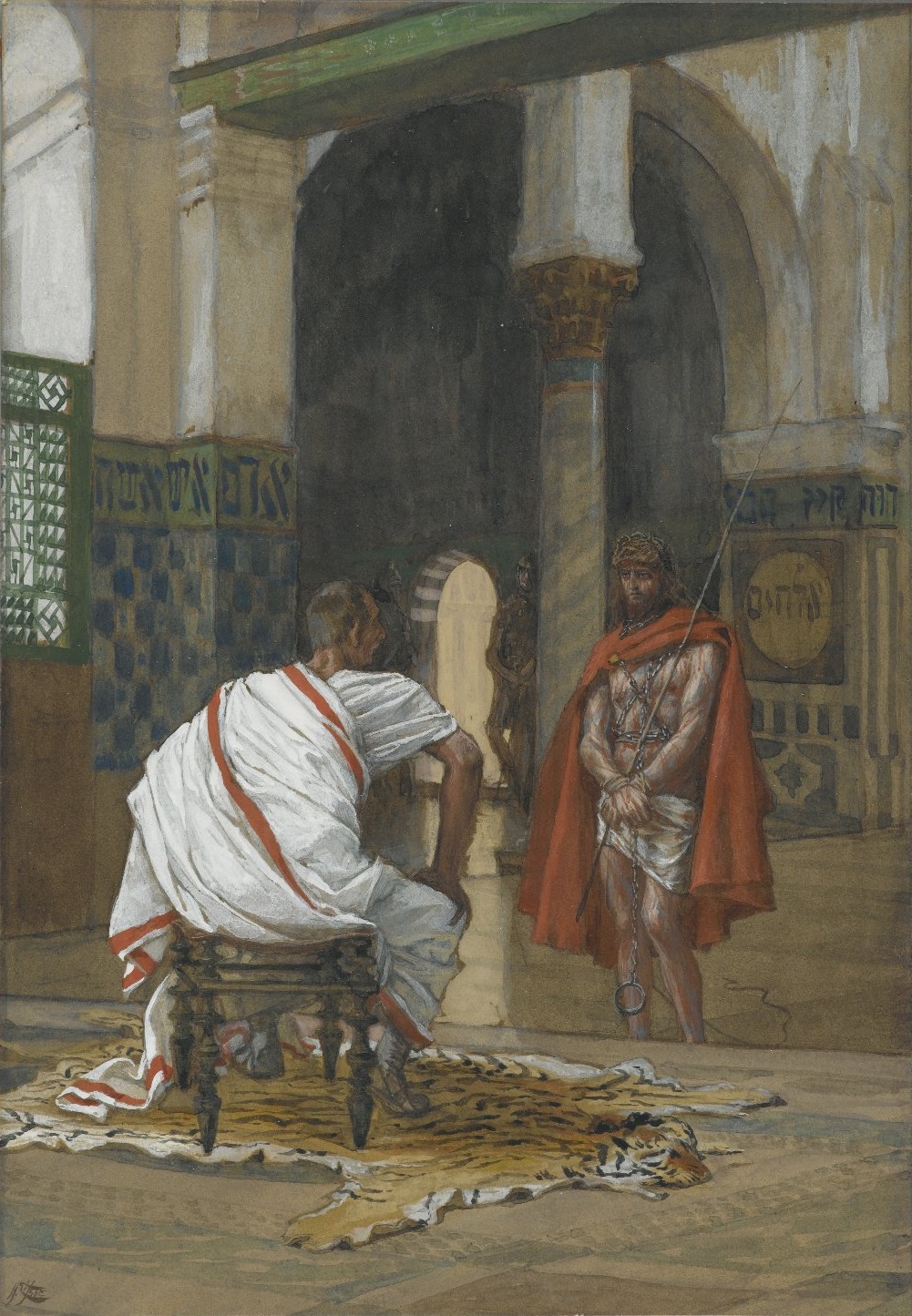
" What!" exclaimed the Governor, " do you not speak to me?  Do you not know that I have both power to crucify you and the power to break your bonds asunder?"

"You should have no power over Me," responded Jesus, " if it were not given you from above."

Jesus before Pilate. J-J Tissot.

Then comparing Pilate's crime with that of the Jews, He distinguished between the guilt of hatred and that of weakness:—

" And this is why the crime of him who delivers Me into your hands is a greater than yours."

Yielding finally to the voice of conscience the Governor determined to release Jesus; again he stepped forth from the Pretorium, whereupon a new storm of cries assailed him.

" If you release this man you are no friend of Caesar; whoever makes himself the King is Caesar's enemy."

Terrible threat, for the Caesar on that day was Tiberius, and no-one there but knew what powers lay in the reach of informers.  Even Herod had not been able to defend himself against the statements of these Jews; his son Archelaus had lately been deposed at their instance; little more than this would be enough to overwhelm Pilate.  Straightway losing sight of Jesus his mind pictured only that suspicious master of his world, who, from the rocky Heights of Caprea, made the earth tremble; saw in a flash the Jews summoning him before this inexorable judge,— the crime of high treason charged against him,— his fortune plundered,— then exile and death.  He could make no stand against these phantoms of his imagination; fear of the future overmastering every other feeling he commanded Jesus to be brought out, and himself ascended the judgment-seat.  It was the eve of the Pasch, about the sixth hour (between half past ten and eleven in the morning); the Jews were surging wildly about the high tribunal where Pilate, although become that all of their hatred, strove still to command respect by invading his terrors under a semblance of haughty contempt.

"And this, then, is your King?" he began again.

But his voice was drowned by the cries of the multitude.

"Away with him, away with him!"

"Crucify him!"

"This is your King; shall I crucify your King?"

"We have no King but Caesar" J-J Tissot.

The one last word gave the spur to his tardy resolution.

"We have no King but Caesar," shouted the chief priests.

Vanquished at last he delivered Jesus into their hands.

His crime was to be severely punished; three years had not elapsed when, upon the depositions of certain Samaritans, Vitellius, Proconsul of Syria, delegated Marcellus there to take in hand the affairs of Judaea, and enjoined Pilate to proceed to Rome, and there clear himself of the accusations brought against him.  The fearful misgivings to which he had succumbed in sacrificing Jesus became realities; condemned in his turn, despoiled of all his property, he was sent into exile.  Vienna still points out, upon the banks of the Rhone, a high pyramid which passes for the tomb of Pilate.  We are told by various traditions that it was here, when dragged down by remorse, the banished man put a violent end to his existence.  Still other religions would have us believe that, in the midst of his misfortunes, he was sought out by the grace of Jesus; and the Abyssinian Church finds a place in the ranks of the saints for this week-spirited man who, nevertheless, was a Christian, says Tertullian, in the fugitive, impotent longings of his soul.

Totus tuus ego sum
Et omnia mea tua sunt;
Tecum semper tutus sum:
Ad Jesum per Mariam.


Friday, September 25, 2020

Jesus at the Praetorium and before Herod: Part 2 of 2

Chapter III: Jesus at the Praetorium and before Herod

John xviii. 28-40; Matt. xxvii. 2, 11-25; Mark xv. 1-14; Luke xxiii. 1-25.


This Prince's suite was quartered in the ancient residence of the Maccabees, to which Herod's sons had retired when their father’s palace was occupied by the Roman governors.  Thither the legionaries conducted Jesus, surrounded by His enemies.  We shall not try to follow the Saviour over this portion of His sorrowful journey; but it is hardly probable that his guards would have forced him to descend the steep side of Moriah and then reascend the Hill of Sion, when by crossing from the western portico of the Temple and over the bridge of Tyropœan, they could at once reach the Prince's palace.

Plan of Jerusalem. Fouard.


The appearance of Jesus before him excited only a frivolous pleasure in Herod's mind, for his depraved soul was now incapable of even such anxieties as were troubling Pilate's conscience.  For a long time he had been kept informed of all the reports concerning the Christ, and he was only too anxious to be an eye-witness of some of His prodigies.  Undoubtedly the young Physician, to escape execution, would satisfy his curiosity by performing some miracle.  Full of such ideas, Herod at first treated the Prisoner with some show of respect, plied Him with questions, and pressed Him to display His supernatural power.

But Jesus had sounded the shallow depths of this Prince's mind; and He, Who had only words of tender mercy for Pilate, deigned not so much as a word in reply to Herod.  This silence disconcerted the Tetrarch; the Sanhedrin-party, on the other hand, were not less deceived.  They had counted upon recovering their ascendancy with a prince of their nation, and without urging any false pretexts, had expected him to strike immediately at what was most hateful to them in Jesus, His Doctrine and His pretensions to the title of the Messiah; but all their furious entreaties and objurgations were thrown away on Herod.

Of Idumean ancestry, though a Jew by birth, and inclining naturally towards the skepticism of the Sadducees, the Tetrarch had long ago stifled his conscience too thoroughly to admit of his now taking any interest in questions of religion.  And, further than this, by condemning Jesus would he not run the risk of a popular movement in His favour?  Or at any rate, there was the possibility of incurring such terrors has had assailed him after the execution of John Baptist!  Anxious above all things not to endanger his own comfort, the despotic egoist lost no time in returning compliment for compliment, by reminding Jesus and back again to Pilate.  

Jesus before Herod. J-J Tissot.

Provoked, however, at having been so set at naught, he desired on his side to display his disdain for the Christ and, in token of division, had Him arrayed in a white robe.  What was this garment meant to travesty?  Perhaps the consul's toga or that of the Roman candidates, thus disguising Jesus as though he were some puppet sovereign of the stage; or was it perhaps the garb assumed by Jews acquitted of capital offence, Herod indicating by this that he regarded the Prisoner as a fool, incapable of any crime?  The Procurator appears to have interpreted it in this last sense, for, in arguing with the people for the life of the Christ, he urged in His defence this burlesque acquittal.

Distasteful as it was to Pilate to resume the trial of which he had thought himself disburthened, yet he took considerable satisfaction from this mark of courtesy on Herod's part, and their mutual deference put an end to all resentment between them.  The Governor's undertakings, hitherto hostile to the Tetrarch's authority; the blood of the Galileans shed in the Temple,— everything in fact was forgotten, and on the same day they became friends.

Jesus led back to Pilate. J-J Tissot.

Once again Jesus was hurried along the road to Antonia.  The insulting magnificence with which He was attired rendered His wretched state more striking. Pilate was touched thereat, and, fortified by Herod's dismissal, endeavoured to wrest their Victim from the Sanhedrin's clutches.  Accordingly he assembled the princes of the priesthood and the magistrates; but they, on their part, bent upon forcing his consent, had collected a mob of the populace in order to influence him further.

With Jesus at his side, Pilate addressed them.

"You have produced this man before me," he said, "and accuse him of exciting that the people; and now I, after having examined him before you, find nothing in him touching what you charge him withal.  And in like manner Herod, to whom I referred you, has found nothing in him worthy of death."

Whether a threatening silence or a fresh outcry greeted these words, Pilate at all events believed it was best to make amends for them somehow, so he added:—

" I will chastise him, therefore, and let him go."

Lightly as he regarded the penalty referred to in these words, it was nonetheless a piece of iniquitous acquiescence on his part, and a sign of weakness which could not escape the Sanhedrin-party.  There he resolved to push their advantage with all their strength.

Meanwhile the crowds were beginning to ascend the approaches to the Fortress Antonia, attracted by the assembly drawn up before the Praetorium or to take part in a ceremony which was always performed just at this time.  During the morning of the Parasceve, the Roman governors, in order to heighten the solemnity of Passover-time, had always granted a pardon to some prisoner designated by the Jews.  This custom, of which we find no trace either in Scripture or in the Rabbinical traditions, had doubtless been introduced by some procurator, anxious to conciliate his new subjects.  Rome, always ready to extend amnesties, either in public calamities or at the anniversaries of the Caesars, afterward consecrated this favour accorded by one of her magistrates, and we see Pilate respecting the observance as though it had all the force of the law.

The sight of the multitudes thronging the square of Gabbatha, and with loud shouts demanding this privilege, suggested a new expedient to Pilate's mind.  Among the condemned who were to be executed according to custom during the Paschal season, there was a man named Barrabas, notorious for his wickedness.  At the head of a riotous herd, he had caused bloodshed in Jerusalem itself, and headed a revolt, not only against the authority of Rome, but against that of the Sanhedrin as well; for it was from their prison that the Governor was about to procure him.  Saint John's explanation, remembering how that the divine Master was compared to him, is testimony enough as to the contempt with which the criminal was popularly regarded:—

"Now Barrabas was a robber!"

Barrabas. J-J Tissot.

Pilate hoped that between this scoundrel and the innocent One Whom they were pursuing, the Jewish populace would not hesitate to give the latter the preference.

"Whom do you wish me to deliver to you?" he cried, "Barrabas, or Jesus who is called Messiah?" And so speaking, he ascended the steps of the tribunal, set before the Praetorium.

No sooner was he seated than some of his servants came in search of him, sent thither by his wife.

From her apartments in the Fortress, she was now looking down upon the scene.  Tradition tells us that her name was Claudia Procula, and that she was a pious lady, one of the "Proselytes of the gate" so numerous just then in the ranks of the Roman nobility; a divine light had shown her that the doctrine of Jesus was still more perfect than the Law of Jehovah.  All the night previous a strange uneasiness had taken possession of her at the first report the young Teacher was to be arrested; nor had sleep in the least calmed her anguish of spirit, but all night long terrible dreams had disturbed her slumbers.  Consequently, when she saw Jesus encircled by the furious mob, with Pilate hesitating and half-prepared to condemn Him, she bade some of her people bear this message to her husband:—

"Let there be nothing between you and that just man, for I have been greatly distressed in a dream this day because of him."

Alone against all these wicked judges, these false witnesses, these inhuman wretches, a pagan woman found, deep down in her heart, enough of strength and tenderness to plead the cause of Jesus.  Of this deed Christians have ever cherished a grateful memory, while the Greeks have given her a place in their Menology in the company of the Saints.

But these few moments had been turn to their own advantage by the priests and magistrates.  Spreading their views through the multitude, they finally succeeded in inflaming them with their fierce passions, persuading them to choose Barrabas in preference to the Saviour.

And so, when Pilate demanded for the second time: " Do you wish me to deliver to you the King of the Jews?" one unanimous shout rose from the surging populace:—

"Rid us of him and release Barrabas!"

"What shall I do, then, with him a whom you call the King of the Jews?" replied the Governor.

"Crucify him, crucify him!" responded the crowd with one voice.

"But what evil has he done?" persisted the judge, now become advocate for his prisoner.  "As for me, I find no cause of death in him.  I will chastise him therefore and let him go."

But then the multitude repeated with wilder tumult,—

"Crucify him, crucify him!"

"Crucify him, crucify him!" J-J Tissot.

"And their horrible efforts against Him grew in strength ever more, clamouring that he might be crucified, whilst still the shouts continued to increase."

Seeing that he gained nothing, while on the contrary the uproar was only swelling, Pilate wished to declare plainly that he looked upon Jesus as a just man, and that he intended to disclaim any responsibility for His death.  There was a custom in Israel which ordained that the magistrates of any city where the author of a murder remained undiscovered should wash their hands over the corpse of the victim, in witness of their own innocence.  This indeed, prescribed by Deuteronomy, served the Governor in place of further speech with the people, who were sharply watching his every action.  He therefore ordered water to be brought, and therewith washed his hands.

" I am innocent of the blood of this just man," he said; " now, then, it is your own concern!"

Whereupon all the people answering said:—

" His blood be upon us and upon our children!"

Pilate had not courage to resist further, and discharging Barrabas, released from his chains, he delivered over the Christ into the hands of the soldiery.  Doubtless he did not mean as yet to abandon Him; but, because whipping was the first preliminary for crucifixion, he hoped that the blood of Jesus would appease His enemies and enable him, even yet, to rescue Him.


Totus tuus ego sum
Et omnia mea tua sunt;
Tecum semper tutus sum:
Ad Jesum per Mariam.


Thursday, September 24, 2020

Jesus at the Pretorium and before Herod: Part 1 of 2

Chapter III: Jesus at the Pretorium and before Herod

John xviii. 28-40; Matt. xxvii. 2, 11-25; Mark xv. 1-14; Luke xxiii. 1-25.


The Sanhedrin, as we have seen, had determined to deliver Jesus to the jurisdiction of Pilate; the priests, however, because their presence was demanded at the Temple for the morning sacrifice, could not accompany Him; but the rest of the assembly formed a lengthy retinue around Jesus, which, after crossing the town, conducted the Prisoner within the precincts of the Pretorium.

The Roman Governors were accustomed to take up their residence in the palaces of the princes whom they had supplanted, and, generally speaking, the Procurators occupied Herod's royal seat on Mount Sion; but during the Paschaltide, Pilate resided in Antonia, the fortress erected north of the Temple and overlooking the porches.  From the steep heights of this citadel, he could beat down any tumult of revolt, while at the same time he enjoyed its large and kingly appointments, its lofty galleries and baths, with the immense courts where his legionaries could all comfortably be encamped.


Jesus before Pilate. J-J Tissot.


Borne along into one of these halls, Jesus stood at last in Pilate's presence.  He was not altogether a stranger to the Governor, for although Galilee and Perea, the usual field of His Ministry, were not subject to the Roman jurisdiction, yet his preaching had so deeply stirred Jerusalem that reports of these events must have reached Caesarea long before now.  

Besides this, Pilate's wife had come to be secretly drawn to the worship of Jehovah, and thereafter, touched by the virtue of Him Whom she called "The Just," she had often conversed with the Procurator concerning Him.  Accordingly we see him fully informed as to everything concerning Jesus, – His title of Christ, the relentless spite of the Sanhedrin, and the bitter fanaticism which had hunted Him down.

The Captive was alone; His accusers, despite their animosity, could not venture to cross the threshold of the Pretorium.  The dread of being contaminated, and thereby debarred from participating in the Passover, could even overmaster the longings which now filled their breasts to support their denunciations in person.  However, if only by the shackles which pinioned Jesus' arms, Pilate would easily understand that the Sanhedrin desired His death, it being their usage to deliver up in this condition such condemned felons as they judged worthy of the extremest penalty of the law.

At sight of Jesus, the first feeling of the judge was one of pity; there was nothing in His attitude which could be attributed to the pride of a seditious brawler, nothing which in any way invited punishment.  Naturally endowed with the keenness common to all Roman politicians, Pilate suspected some plot and began to think that perhaps he would find occasion to revise rather than to confirm the Sanhedrin's sentence.  Nevertheless, out of respect for the Jews' scruples who refused to enter within the house, he went forth and met them in the outer court.

"What accusation," he enquired, "do you bring against this man?"

The Sanhedrin had hoped that their eagerness and the moment at which they presented themselves would have prevailed with Pilate.  Their disappointment found is utterance in better terms.

"If this man were not a malefactor we would not have delivered him up to you."

This arrogant answer pricked the Governor's temper, and he responded in turn with an accent of irony and disdain.

"Take him yourselves," he said, "and judge him according to your laws."

Would not excommunication, with thirty-nine lashes from the whip, administered in the synagogue, be enough to punish any infringement of their rights?

" We no longer have the power of putting any one to death," replied the Jews, disclosing in this manner how far they wished to proceed.  Mysterious disposition of Providence!  God had deprived them of all power over human life only that they might not stone the Christ, according to the Law, but that Rome should lift Him up upon the Cross, " whereby He shall draw all men unto Him."1 Thus it was necessary that the saying of Jesus wherein He foretold by what death He was to die should be fulfilled.

Evidently Pilate up was not inclined to ratify the condemnation of Jesus, but intended to review the whole procedure and judge the case for himself.  Summoned to produce the leading points in their accusation, the Sanhedrin resigned themselves to necessity.  The title, "the Son of God," which the Saviour had attributed to Himself, though the real cause of His ruin, was left unnoticed; but since by declaring Himself the Christ He thereby proclaimed Himself King of Israel, the latter claim was urged against Him, as of itself crime enough; and the accusation, reduced to these three charges, was so framed in order to stir Pilate up to a vengeance most surely.

" We have found him," they said, "exciting the people, forbidding to pay tribute to Caesar, and calling himself the Christ-King."

But Pilate knew the Jews too well to be duped by their sudden zeal to avenge the wrongs of Rome.  And besides this, his officers had not informed him of any signs of an incipient conspiracy, nor of any refusal to submit to the taxes.  Hence he lent scanty credence to rumours of a sedition which would have given him little trouble to repress; but the word Christ caught his attention.  What was the significance of this title, which seemed to involve at once a civil and a religious dignity?  What royalty could the Prisoner now in his hands lay claim to?  Determined upon getting some light upon this question, Pilate re-entered the Pretorium and summoned Jesus.

Thus, then, the Saviour was left alone with His judge,— far removed from the Jews whose distant cries of "Death to the Nazarene!" still reached His ears. Pilate, by screening Him from their furious clamour, had already let it be seen that his heart was not indifferent to the spectacle of such misfortunes.  Jesus, far from profiting by this to plead His own interests, was altogether absorbed in the cause of eternal Truth, and sought only to make it to descend within the soul of this man now standing before Him, – puzzled and uncertain, still in the darkness, yet just catching a glimpse of some celestial radiance meanwhile. Pilate was the first to speak.

"Are you truly King of the Jews?" He asked Jesus.

Always more attentive to the thought than to the words of His questioners, the Saviour answered him:—

" Do you say this of yourself, or have others told you this of Me?"

Surprise at finding his mind so easily penetrated, the Governor responded, brusquely:—

"Am I a Jew, forsooth?  Your nation and your Pontiffs have delivered you up to me.  What have you done?"

This question drew forth no reply.  Altogether intent upon the inward struggle which was now agitating Pilate, Jesus beheld with infinite compassion that he was trying to crush down the movements of grace which were calling him to the truth, his conscience besetting him ever more with that persistent question:—

"What, then, is this kingdom of his?"

Accordingly it was rather to this unspoken and secret question that the Christ made the answer,—

"My Kingdom is not of this world.  If My Kingdom were of this world, My Ministers would strive that I should not be delivered to the Jews." But—as you may see from My fetters, from My forsaken state—"My Kingdom is not from hence."

"Then you are a king?" exclaimed Pilate.

"Thou hast said it," answered Jesus; and He added words which Saint John has not recorded at length, but certainly they were sufficient to confirm this declaration:

" I was born and I came into the world in order to render homage unto the Truth.  Whosoever is of the Truth heareth My voice!"

"What is truth?" queried Pilate, and then at once turned away, to escape the ascendancy which Jesus was exerting over him.

And with this thought he went out to the Jews and bespoke them again, with the assertion,—

"I find nothing worthy of death in this man."

At this answer to their appeals, the cries of rage burst out more wildly than before.  The priests and ancients persisted with great violence, besieging the Governor's ears with accusations which grew ever vaguer, more contradictory and often entirely incomprehensible to him.  He had Jesus brought forth.  His very presence excited a new fury of abuse; indeed it would seem, from Saint Matthew's text, that the Sanhedrin-Councillors began to cross-question Him directly, but all to no purpose.

"Do you not hear," Pilate said, turning toward Him, "of how many things they accuse you?"

Still Jesus answered not a word.  This silence, this peaceful calm in the midst of a raging rabble, filled the Governor with admiration.

He was now casting about for some escape from his predicament, while still the Jews pleaded with fiercer persistency; this time asserting,—

" He stirs up the people, teaching throughout all Judaea, beginning from Galilee to this place."

The name " Galilee" was a ray of light,—thrown out with the design of reminding the judge of the uneasy character of that province and the blood of its conspirators lately shed in the Temple; but on the contrary, it only suggested an expedient whereby he might extricate himself from all responsibility in the affair.  Immediately Pilate demanded whether Jesus was a Galilean, and having learned that He belonged to Herod's jurisdiction, he remanded Him to the Tetrarch forthwith.


Totus tuus ego sum
Et omnia mea tua sunt;
Tecum semper tutus sum:
Ad Jesum per Mariam.

Wednesday, September 23, 2020

Death of Judas

V: Death of Judas

Matt. xxvii. 3-10; Acts i.16-19.


By a righteous retribution of human nature, the first victim of this iniquitous judgment was the very man who had been its prime mover and first cause.  Standing unheeded among the rubble of onlookers, in silence Judas had looked long and intently upon his Victim, now finally separated from him; disquieted at heart, uneasy, still cherishing some secret hope perhaps that Jesus would overwhelm His judges and escape them in the end.  But when he had witnessed His condemnation and had followed Him as far as the Governor’s Palace, remorse was at last fully aroused in him.  The life of Jesus, as he had witnessed it day by day, seemed to repass before his eyes in one mighty but distinct whole, and the last words of the Master resounded in his ears like an audible rebuke.  Crushed and distraught with shame, possessed with a sort of madness, he started forthwith, not in search of Jesus Who would have repaid him with peace and salvation, but bent upon finding the priests who had been his accomplices in crime. He had noted that, upon leaving the Palace of Caïphas, they turned down the street leading to the Temple; thither he repaired and mounted the stairway which divides the Sanctuary from the Gentiles' Court.  Between the Priests' porches and those of the Jews stood there Hall of Gazith.  Although it was no longer the regular assembly-chamber for the Sanhedrin, everything leads us to presume a that it was here Judas found the Priest and ancients gathered together.

" I have sinned," he cried; "I have betrayed the blood of The Just One;" and his shaking hand held out the thirty shekels before their faces.

The only reply to this wretched appeal with disdainful enough:—

"What does that matter to us?  That is your affair."

Judas returns the thirty shekels. J-J Tissot.

Judas drew back the silver; then, in a frenzy of despair, as he crossed the great entrance of the Holy Place, he flung down the price of his treachery, there on the threshold, and disappeared.

The Priests picked up the coins; hard by stood huge coffers destined to receive alms-gifts.

"It is not permitted to us," they said, "to put this money into the Treasury, since it is the price of blood."

O marvelous scrupulousity of these Doctors of Israel, so accustomed to listen to nothing but their own evil passions, yet requiring so much deliberation before deciding as to the disposition of thirty pieces of silver!  Happily Judas came to their aid.

On quitting the Temple, he took the road which descends towards the Fountain of Siloë.  At the spot where Kedron joins Brook-Hinnom, he started up the sombre recesses of the latter, whose aspect was not of a nature to soothe his despairing soul.  Even today, Jerusalem has no chillier nor gloomier region,—the deep, narrow gorge, the beetling cliffs of jagged rocks, overshadowed here and there with dark olive trees, while still in this deep ravine, long ago coerced by Jeremy, the memory of those sacrifices to Moloch seems always to rise uppermost in one's mind.  

Judas made his way up the acclivity which arises opposite Mount Sion, and came to a halt in a clay field belonging to a potter thereabouts.  From this point his eye could sweep the whole pathway, along which he had last night dragged his Victim, from Gethsemane to the Pontiff's Palace; and, as he gazed, his mind altogether gave way under the burthen of mad despair.  Then, says Saint Matthew, "he went and hanged himself;" and in the Acts it is added to that "the rope broke; his body, falling headlong to the earth, burst asunder, and his bowels were spilled over the Field of Blood." When informed of his death the Sanhedrin-Councillors hastened to dispose of their accomplice, whose conscience-stricken end would go far toward witnessing to the innocence of Jesus.  The thirty shekels which were once Judas's, still lay in their hands; with them they purchased the Potter's field, in order to bury the body on the very spot where its bowels had gushed forth; then, hoping to efface the memory of his crime, they consecrated this region as a burial place for such foreign proselytes as should thereafter die in the city.  But the citizens of Jerusalem were informed of the tragic end of Judas, and, as this accursed ground had drunk the blood of the traitor, they called it Haceldama,— "the  Field of Blood." 

Judas hangs himself. J-J Tissot.

Saint Matthew, as he is wont to do, here again refers to the words of the ancient Prophets.  This, then, was the very scene which and Jeremy had had before his prophetic vision when long since he descended Hinnom Valley, before ever it was blasted by God's maledictions.  It was a garden of delight, whose wooded banks were freshened by the waters of Siloë; but beneath its shadowing arches and round about the faggots heaped up in honour of Moloch there had re-echoed unholy choruses, mingling with the clash of symbols and psalteries.  The Prophet advanced, followed by the Elders of the priesthood and the people, holding in his hand a vessel of that very same clay which in after days was to enclose the remains of Judas; and he broke it in their presence, saying:—

" I will break this City and this people even as this vessel whose fragments can never more be put together, and Tophet shall become a field of sepulchres and corpses."

So, likewise, it was Judas' crime which Zachary had predicted when predicting the ingratitude of Israel, Jehovah's chosen flock, he describes these people giving it unto its shepherd, for a recompense, thirty shekels,—which is the price of a slave; and the shepherd seizes this goodly wage, the price whereat Jesus was valued in the eyes of the Jews, that's so it might be thrown to the Potter, in payment of his waste ground.

By these Prophecies the Lord had revealed His betrayal long beforehand, and now He had committed it to be fulfilled.

Totus tuus ego sum
Et omnia mea tua sunt;
Tecum semper tutus sum:
Ad Jesum per Mariam.

Tuesday, September 22, 2020

The Second Sitting of the Sanhedrin

II: The Second Sitting of the Sanhedrin

Luke xxii. 63-71, xxiii. 1; Matt. xxvii. 1,2; Mark xv. 1; John xviii. 28.


Handed over to the Sanhedrin-guards, Jesus had to endure still greater indignities.  Saint Luke, who omits the account of that night-session before Caïphas, first depicts the Saviour in the centre of this crowd of lackeys and grooms,1 insulted, beaten, and buffeted.  "They blindfolded His eyes," he says, "and smiting Him on the face challenged Him to prophesy, and they uttered many other taunts and insults against Him."

Jesus remained for more than an hour at the mercy of their pitiless hands, for not until morning and broad daylight did the members of the Sanhedrin summon Him again before them.

Ever since early dawn they had been closeted, advising as to the best means of executing the sentence which they had just pronounced against Jesus.  The first requisite was to obtain the approval of the Procurator, Pontius Pilate; for since the exile of Archelaus and the final subjugation of Judaea the Sanhedrin had no longer any power to punish its prisoners with death.  Rome, tolerant though she always was towards the religion of the vanquished, nevertheless reserved to herself the administration of justice, and charged the pro-consuls to study local customs, in order to make them, if possible, accord with the Roman Code, and so form a body of laws peculiar to each region.  It is true the general control of affairs was left to the ordinary judges of the province; but matters of appeal, any important suits, and especially all cases of capital offence, remained subject to the Governor.  So, however jealous of their authority these Councillors might be, they were obliged to bend beneath the yoke which at present held the world in check; yet in this instance they resigned themselves to necessity more willingly, because the concurrence of Pontius Pilate, by relieving them of all responsibility, would prevent any possible conflict with the people.  For suppose that in a throng like the one which, five days ago, had cheered the Saviour's entry,— suppose that some one of the sick folk, cured by His word, should utter his indignation at the condition to which their hatred had reduced Him; would not this be enough to excite an uprising, in the hope of rescuing Jesus?  This was quite reason enough for their eagerness to have Him put into the safe keeping of Roman power, with a further hope of inducing the Governor to ratify their condemnation.

Their negotiations were destined to meet with considerable difficulties, for Pilate, however ready for bloodshed in moments of confusion and riot, in matters of public business cherished all a Roman’s reverence for juridical forms.  Now everything of the sort had been set at naught in the present procedure.  There were certain prescriptions, wise as they were humane, which ordered that the judges should observe a fast, not pronouncing sentence until after mature consideration, and in cases of capital offence they must even defer a decision until at least one day after the examination.  Furthermore, by the same Rules the Sanhedrin was forbidden to assemble during the night, or to hold any sittings before the early sacrifice, which was offered at sunrise. Caïphas and his colleagues could not have been ignorant either of these statutes or of the contents displayed towards them by such actions as they were now committing.

Anxious above all things to cover up any such irregularities on their part, they thought to accomplish their object by causing Jesus to appear before them again just at daybreak.  The short interval which elapsed between the night-sitting and that of the morning did not alter the fact that the rule which commanded a day's delay was in reality infringed; for the Jewish law counted the day from evening to evening.  Yes to this distinction between night and day gave some slight semblance of legality to their proceedings, and therewith their hatred of the Sanhedrin was fain to rest content.

Accordingly Jesus was hauled before His judges, and Caïphas began by repeatedly enquiring:—

" If you are the Christ, tell us."

"If I tell you," He replied, " you will not believe Me, and if I question you, you will not answer Me, nor let Me go."

Thus He reminded these Councillors of State that, only a few hours earlier and in their presence, He had proclaimed Himself the Messiah, and that they had refused to believe Him.  Why, then, should they believe Him now?  Every question which, since His return to Jerusalem, he had addressed to them, whether it concerned John's baptism or had reference to the Christ, was still left unanswered.  They did not intend to answer Him now any more than hitherto they had done; as for releasing Him, that they would never do.  And notwithstanding this, Jesus consented to repeat once again and in the same terms, what He had said during the night just past,— that He was the Son of Man and Son of God.  Vainly had they struck and bruised Him, covering Him with spittle and vile abuse; thereafter, even as before this opprobrium, He revealed to His executioners how, afar off, their Victim was to appear all triumphant in the panoply of celestial Glory, seated at the right hand of the Most-High.

"You, then, are the Son of God?" was ae demand of the Sanhedrin.

"You have said it," reply Jesus; " I am He."

"What further need have we of witnesses?" they cried instantly, "we have heard it for ourselves, from his own mouth."

Storing into their feet at these words, they ordered Jesus to be bound still more closely and hurried him away to the Praetorium forthwith.

Jesus is led away to Pilate. J-J Tissot


Totus tuus ego sum
Et omnia mea tua sunt;
Tecum semper tutus sum:
Ad Jesum per Mariam.


Monday, September 21, 2020

Peter's Denial

II: Peter's Denial

John xviii. 12-18, 25-27; Luke xxii. 54-62; Matt. xxvi. 58, 69-75;Mark mxiv. 54, 66-72.


During this same night was accomplished what was foretold them by the Lord: while He stood for His trial before Annas and Caïphas, Peter, the Chief of the Apostles, denied Him thrice.

The Evangelists note with considerable care the moment of these acts of infidelity; but they report the language and the circumstances so differently that it is quite impossible to regard them as the same words uttered on the same occasions.  Instead of limiting the recusancy of the Apostle to three disavowals framed by his lips, we believe it more likely that three distinct times during this night Peter was recognized by various persons, and that on least three occasions he proved false to his master, each time reiterating his denial under different forms and before more than one witness.  No one thing goes so far toward proving the independence of each single Evangelist regarding the others as the freedom which they display in making their selections from the words and actions which still remained fresh in their memories, and the little pains they are at in order to make their narratives agree upon such points as this.  

When we compare the evidence, with this idea in mind, and without confusing their testimony, we find that each of them furnishes us with some new features in the stories, wherein the abundance of details, the variety and stirring movements of the characters serve to set Peter's falsehoods and downfall in stronger relief.  To clearly understand the order of the incidents it behoves us to return to the first hours succeeding the scene in the garden.

Peter and John follow Jesus. J-J Tissot

Two of the Apostles, after recovering from their first terror, retraced their steps in order to follow the road taken by the Saviour.  Peter, who was one of them, lingered at a distance, but the other disciple drew nearer the troop of armed men; it was John, henceforth steadfastly exposing himself to every peril at the Master's side, and never quitting His sight.  As he was known at the pontifical palace he managed to enter there with Jesus, not noticing that his companion no longer followed him.  The latter, fearing to appear inside the courtyard, hung back in the darkness without.  

Perceiving his absence John went out, spoke a word to the servant-maid who tended the wicket, and so introduced him into the house.

Casting a curious glance at the stranger, the portress asked sharply: " Aren't you to one of this man's disciples?"

Peter's first denial.J-J Tissot.


"No, I am not!" Replied Peter, and hurried quickly out of her away. 

At this season of the year the night time in Judaea is all the cooler in proportion to the extreme heats of the day.  To protect themselves from the cold the guards and manservant had lighted in the lower court a small pile of such thorny brushwood as grows in abundance about Jerusalem.  Seated in this little circle Peter was warming his trembling hands, "awaiting the end," when for the second time he encountered the keen glance of the portress.

She was scrutinising him fixedly by the aid of the firelight.

" Certainly," she said, " you were with Jesus of Nazareth."

Then before all present Peter denied Him, saying, " I do not know what you mean to assert."

But she persisted that she was right, telling the others:—

"Certainly, I know he was with him."

Peter's second denial. J-J Tissot.

"Woman," Peter retorted again, "I do not even know Him."

Then in great trouble of mind he walked away from the group of curious bystanders; and at that moment was heard the first crow of the cock.

As he neared the great door he met with another maidservant, to whom it would seem the portress had confided her suspicions.  She too said to the waiting men and the rest standing about,—

"This man was with Jesus of Nazareth."

And Peter denied it with an oath.

The other maid in charge of the doorr had persisted in following after him, and at this she spoke up again,—

"Surely," she said, "this is one of them."

Again he denied it.

One of the spectators in this scene addressed the Apostle with the query: "What!  Are you one of that set yonder?"

"Man," retorted Peter, "I am not one of them."

John had heard the first denial at the entrance way of the palace, but altogether bent thereafter upon watching the trial of Jesus he was not a witness to the scenes just enacted, and related by the Synoptic Writers only.  When he glanced out into the court the servants were stirring up the fire and warming themselves, for the night air was growing exceeding chill.  Peter, stationed near them, still stood there warming himself.  Driven back from the door by his harassing questioners he had returned to his former standing place.  John overheard the voice of someone saying to him:—

"You too are one of his disciples;" whereat he replied:—

"No, I am not."

Tired at last of questioning him they left him unmolested for nearly an hour, but at length, after he had been drawn into a moment's conversation with his neighbours, they exclaimed:—

"Certainly you are one of his disciples, for your accent betrays you.  You are a Galilean."

One of the High-Priest's servants, a kinsman of Malchus whose ear Peter had cut off, added:—

"Did I not see you in the garden with him?"

Once more Peter's courage failed him.

"I do not know what you're talking about," he cried; "I do not know this Man of Whom are you speak." And his fear betrayed itself in a stream of curses and oaths.  He was still fiercely protesting when the cock crew for the second time.

Peter's third denial. J-J Tissot.

It was then that Jesus turned and looked at him.

This was more than Peter could bear.  Suddenly he remembered how the Master had said to him:—

"Before cock-crow thou shalt have denied Me thrice."

Overwhelmed with despair and beside himself, he had no further thought of the danger which threatened his steps.  At his great outburst of grief the crowd fell back in surprise, leaving him a free passage.  Rushing by the more he found his way out of the palace, and, thinking upon the words of Jesus, he wept bitterly.

Peter wept bitterly. J-J Tissot.


Totus tuus ego sum
Et omnia mea tua sunt;
Tecum semper tutus sum:
Ad Jesum per Mariam.